






Walking into a bank in the Middle East to discuss your Bitcoin holdings can feel like stepping onto a minefield. One moment you are discussing savings, and the next, you might be told that processing cryptocurrency transactions is strictly prohibited. For years, the Gulf Cooperation Council (GCC) has been viewed as a cautious region when it comes to digital assets. But the reality is far more complex than a simple "yes" or "no."
As of mid-2026, the landscape of crypto banking bans across the Middle East is not uniform. It is a patchwork quilt of prohibitions, licensing frameworks, and strategic experiments. Some countries have slammed the door shut on private cryptocurrencies entirely, while others are quietly building the infrastructure for their own digital currencies. If you are a trader, an investor, or a fintech entrepreneur operating in this region, understanding these nuances is critical. You cannot afford to guess which bank will freeze your account.
The Saudi Arabia Approach: Restricted but Managed
Saudi Arabia sits at the center of this regulatory tension. The country does not recognize cryptocurrencies as legal tender. In fact, the Saudi Arabian Monetary Authority (SAMA) explicitly prohibits banks and financial institutions from engaging in cryptocurrency transactions unless they obtain specific, hard-to-get approval. This policy has been consistent since formal warnings were issued by the Ministry of Finance back in 2019.
However, calling Saudi Arabia a total ban state would be misleading. While retail banking channels are blocked for crypto transfers, the kingdom is deeply invested in blockchain technology. Saudi Arabia is an active participant in the mBridge pilot program, a massive cross-border Central Bank Digital Currency (CBDC) initiative alongside the UAE, China, Thailand, and Hong Kong.
This creates a dual-track system. On one side, you have strict prohibitions on private crypto assets flowing through traditional banks to protect financial stability. On the other side, you have a fintech sandbox where controlled experimentation with blockchain occurs. For businesses, this means you cannot just use a standard business checking account to move stablecoins. But if you are working within the regulated sandbox or dealing with tokenized real-world assets under supervision, there is a pathway. The key takeaway? Private crypto is out; state-sanctioned digital finance is in.
United Arab Emirates: The Structured Leader
If Saudi Arabia is cautious, the United Arab Emirates is calculated. The UAE has positioned itself as the regional hub for digital asset innovation, but it maintains strict controls over its banking sector. Under the current framework, only approved tokens, such as Dirham Payment Tokens, are permitted for payments. Any unlicensed cryptocurrency activity by financial institutions is strictly prohibited.
The Central Bank of the UAE distinguishes clearly between permitted and restricted activities. Banks operate under guidelines that separate legitimate, licensed digital asset services from speculative trading. This clarity is what makes the UAE attractive to institutional players. Unlike the ambiguity in some neighboring regions, UAE banks know exactly what lines they cannot cross.
The UAE’s interest goes beyond regulation; it is about infrastructure. Since Project Aber launched interoperability tests for cross-border CBDC transactions in 2019, the country has been refining its technical capabilities. The goal is not to stop digital money but to control it. For users, this means you can trade crypto on licensed exchanges in Dubai or Abu Dhabi, but moving those funds through a traditional commercial bank account remains highly restricted and often blocked by compliance filters.
Qatar: The Strictest Ban with Nuanced Exceptions
Qatar represents the most restrictive end of the spectrum. For a long time, the message was simple: no crypto. The Qatar Financial Centre Regulatory Authority (QFCRA) expanded initial 2018 prohibitions to a complete ban on virtual asset services in the Qatar Financial Centre by 2020. If you tried to offer crypto services here, you were shutting down.
But 2024 brought a significant shift. The introduction of the Digital Asset Regulations 2024 legalized certain tokenized assets, specifically shares and bonds. However, cryptocurrencies like Bitcoin and stablecoins were explicitly designated as "Excluded Tokens." This means that while the underlying technology of tokenization is welcome for traditional finance, speculative cryptocurrencies remain banned for all financial institutions.
This distinction is vital for investors. You might see news about Qatar embracing blockchain for stock markets, but do not confuse this with permission to bank crypto. The QFCRA expects businesses to adhere to these prohibitions rather than implementing detailed Anti-Money Laundering (AML) requirements for crypto, because most crypto-related services simply do not exist legally. As we move through 2026, the Qatar Financial Centre is finalizing a broader digital asset regulatory framework, but expect it to maintain the same strict separation between utility tokens and speculative crypto.

Kuwait and Bahrain: Enforcement vs. Licensing
Kuwait has taken the most aggressive enforcement route. The government views crypto mining as a threat to national resources, particularly electricity. Following strict enforcement measures, local electricity usage for mining dropped by 55%. This demonstrates Kuwait's commitment to excluding itself from the global crypto market. Digital assets are not legal tender, and the banking sector reflects this by maintaining comprehensive restrictions. There is little room for negotiation here.
Bahrain, conversely, offers a middle ground. The Central Bank of Bahrain operates a Crypto-Asset (CRA) module that determines permitted activities. Unlike Qatar or Kuwait, Bahrain allows financial institutions to engage in approved cryptocurrency activities under a clear licensing regime. They have conducted interoperability tests with major players like JP Morgan and maintain active CBDC piloting programs.
For a fintech startup, Bahrain is often easier to navigate than Kuwait because the rules are written down. You apply for a license, you follow the CRA module, and you can operate. But "approved" does not mean "open." Unlicensed operations are still prohibited, and the bar for approval is high. It is a regulated gate, not an open field.
Oman: Emerging Alignment
Oman follows the broader trends set by its larger neighbors. While specific, granular regulations are still maturing, Oman participates in regional CBDC pilot programs. This indicates a movement toward defined frameworks that will likely restrict unauthorized banking activities while permitting licensed operations. If you are planning a long-term strategy for Oman, watch the developments in Saudi Arabia and the UAE, as Oman tends to align its policies with these regional leaders.
| Country | Banking Status | Key Regulator | Notable Exception/Focus |
|---|---|---|---|
| Saudi Arabia | Restricted + Managed | SAMA | mBridge CBDC Pilot; Fintech Sandbox |
| UAE | Licensed Only | Central Bank of UAE | Dirham Payment Tokens; Project Aber |
| Qatar | Strict Ban (Speculative) | QFCRA | Tokenized Shares/Bonds Allowed; Crypto Excluded |
| Kuwait | Comprehensive Restriction | Central Bank of Kuwait | Aggressive Mining Crackdowns |
| Bahrain | Licensing Regime | Central Bank of Bahrain | CRA Module; Institutional Interoperability |
| Oman | Emerging Framework | Central Bank of Oman | Regional CBDC Participation |
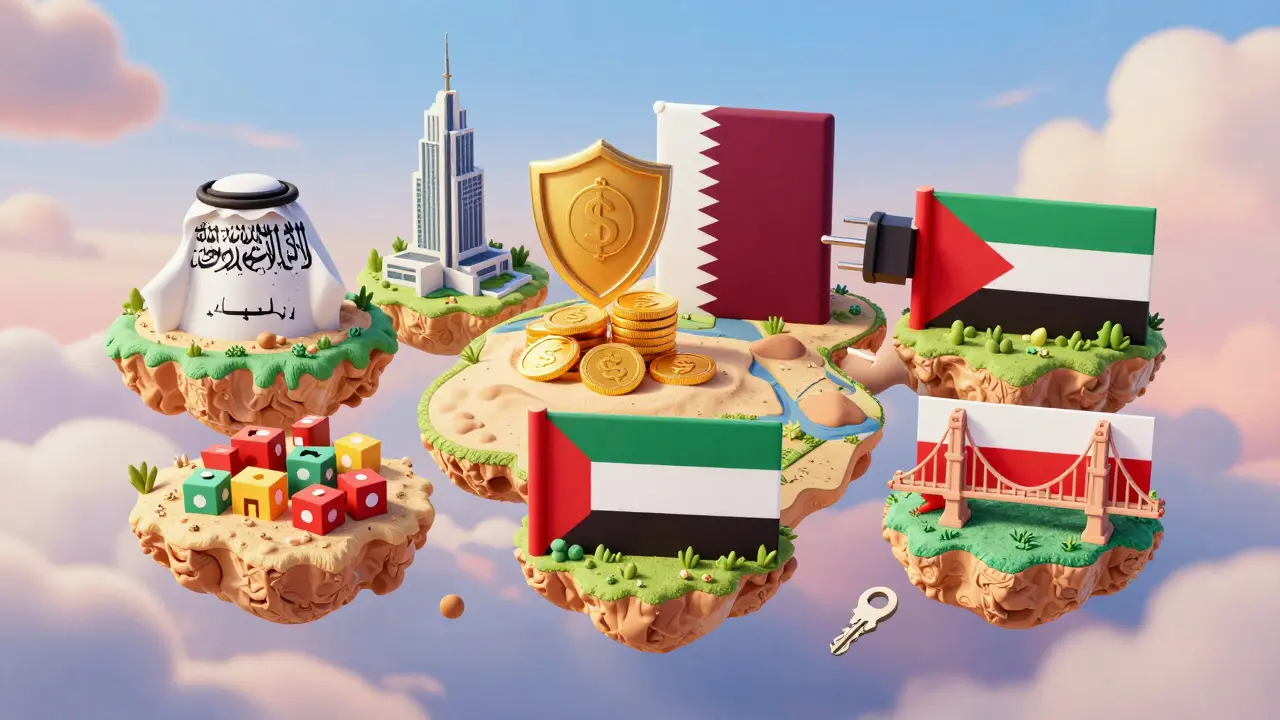
Why the Bans Exist: Economic Diversification
It is easy to view these bans as purely anti-crypto sentiment, but that misses the bigger picture. According to analysis from the Carnegie Endowment for International Peace, these restrictions are part of a broader economic diversification strategy. GCC countries are trying to reduce their reliance on Western financial systems and the US dollar.
Harvard researcher Ala'a Kolkaila notes that digital finance is central to this national economic diversification. By banning private, volatile cryptocurrencies from the banking sector, governments protect their citizens from fraud and instability. Simultaneously, they invest heavily in CBDCs to gain sovereignty over their monetary systems. The bans are not against technology; they are against uncontrolled risk. Governments want the efficiency of blockchain without the chaos of decentralized speculation.
Navigating the Restrictions: Practical Advice
So, what does this mean for you? If you are holding crypto in a Middle Eastern wallet, you likely cannot deposit fiat directly from your local bank account to a major exchange like Binance or Coinbase without triggering compliance alerts. Here is how to navigate this:
- Use Licensed Exchanges: In the UAE and Bahrain, stick to platforms that hold local licenses. These entities have established relationships with regulators and may offer clearer pathways for fiat on-ramps.
- Avoid Direct Bank Transfers: Do not attempt to wire large sums labeled as "crypto purchase" from a traditional GCC bank. The transaction will likely be frozen or rejected. Use peer-to-peer (P2P) methods or third-party payment processors where legally permissible.
- Watch for Tokenization Opportunities: Keep an eye on Qatar and Saudi Arabia for opportunities involving tokenized real-world assets (like bonds or shares). These are becoming legal and may offer yield opportunities that traditional crypto trading does not.
- Stay Updated on CBDC Pilots: The mBridge project and national CBDC trials are evolving. While you cannot use them yet as a retail user, their success could pave the way for more integrated banking solutions in the future.
The Future Outlook: Gradual Liberalization?
Will these bans disappear? Probably not entirely. The distinction between retail crypto trading and institutional banking services is too important for financial stability. However, we are seeing a gradual liberalization of the *frameworks* around them.
Qatar’s expected completion of its digital asset regulatory framework in Q2 2025 (now past) serves as a model for regional standardization. We may see more countries adopt similar "excluded token" lists, allowing safe, utility-based blockchain applications while keeping speculative assets at bay. Regional collaboration through projects like mBridge suggests that the infrastructure for secure digital asset operations is being built right now. The future of banking in the Middle East will likely involve a hybrid model: strict controls on private crypto, but seamless integration of state-backed digital currencies and regulated tokenized assets.
Can I transfer Bitcoin to my bank account in Saudi Arabia?
Generally, no. SAMA prohibits banks from engaging in cryptocurrency transactions without specific approval. Most retail customers will find that direct transfers between crypto exchanges and local bank accounts are blocked by compliance filters.
Is crypto legal in the UAE?
Yes, but it is heavily regulated. Trading on licensed exchanges is permitted, and specific tokens like Dirham Payment Tokens are approved for payments. However, unlicensed activities and using traditional banks for unapproved crypto transfers are prohibited.
What happened to crypto regulations in Qatar in 2024?
Qatar introduced the Digital Asset Regulations 2024, which legalized tokenized assets like shares and bonds. However, cryptocurrencies and stablecoins remain classified as "Excluded Tokens," meaning they are still banned for financial institutions.
Why is Kuwait so strict on crypto mining?
Kuwait views crypto mining as a drain on national electricity resources. Enforcement actions led to a 55% drop in mining-related electricity usage, reflecting a zero-tolerance policy for activities that consume public energy for private speculative gains.
What is the mBridge project?
mBridge is a multi-country pilot program for a Central Bank Digital Currency (CBDC) designed to facilitate cross-border payments. Saudi Arabia, the UAE, China, Thailand, and Hong Kong are participants, aiming to create a faster, cheaper alternative to traditional SWIFT transfers.
Can I get a crypto license in Bahrain?
Yes. The Central Bank of Bahrain offers a Crypto-Asset (CRA) module that allows financial institutions to apply for licenses to conduct permitted crypto-asset activities. It is one of the more accessible regulatory frameworks in the GCC.