




Paxe (PAXE) is not just another cryptocurrency. It’s a DeFi yield aggregator built to help users earn more from their crypto holdings by automatically moving funds across multiple blockchain networks. If you’ve ever tried to farm yields on Ethereum, BNB Chain, or Polygon and ended up juggling five different apps, Paxe was designed to fix that. But here’s the catch: despite its ambitious goals, the token has lost over 99% of its peak value. So what’s really going on with PAXE?
What does Paxe (PAXE) actually do?
Paxe operates as a multi-chain yield portal. That means it takes your tokens-like ETH, MATIC, or BNB-and automatically deposits them into the highest-yielding DeFi farms across different blockchains. Instead of manually checking which farm on Polygon is paying 15% APY and which one on BNB Chain is offering 22%, Paxe does it for you. The platform uses smart contracts to move your assets between partner protocols, aiming to maximize returns without you lifting a finger.The core idea is simple: don’t let your crypto sit idle. Put it into Paxe, and it gets redeployed into farms that are currently paying the best rates. In return, you earn PAXE tokens as rewards. The platform also issues tokenized positions like stPAXE, pMATIC, and pBNB-these represent your stake and let you earn points that could unlock future airdrops.
How does PAXE work technically?
Paxe runs on the BNB Smart Chain (BEP20) and uses its own contract address:0xd2a3eec06719d5ac66248003b5488e02165dd2fa. You can add this to MetaMask to track your holdings. The token has a fixed total supply of 100 million PAXE, but only 3 million are currently in circulation. That’s a big red flag for some investors-low circulating supply can mean high volatility or even manipulation.
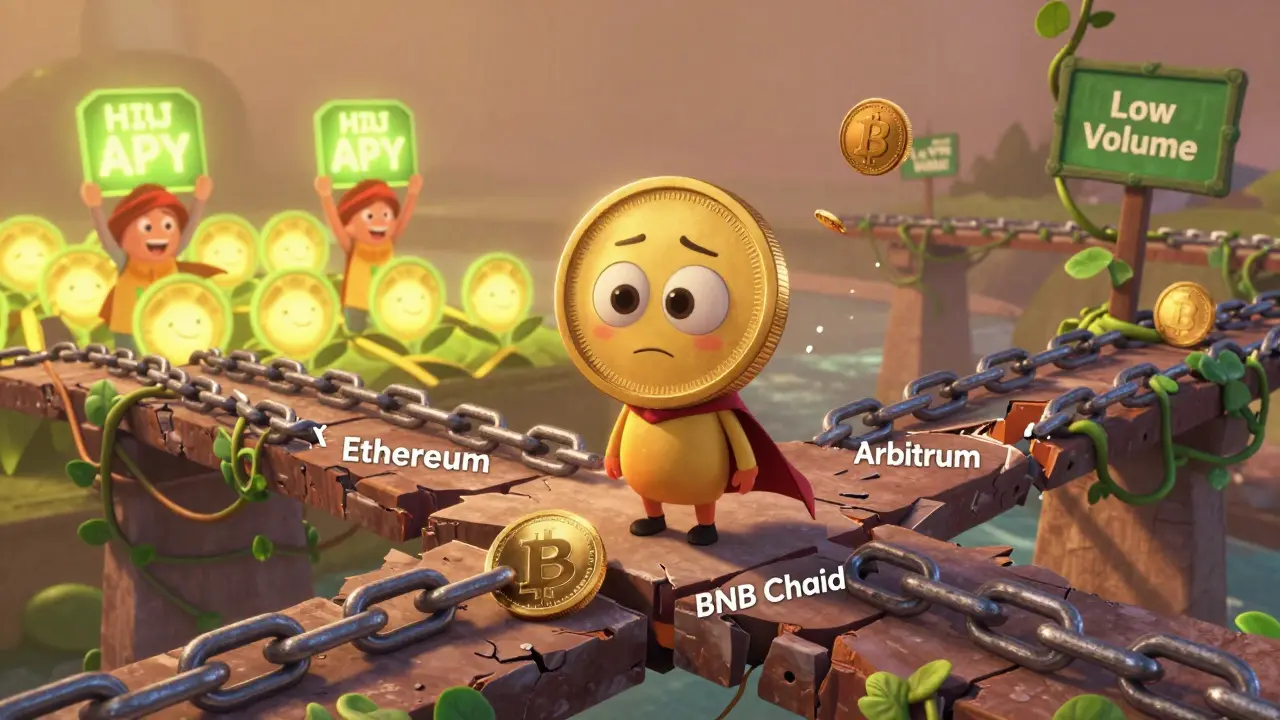
The platform claims to support Ethereum, Polygon, Arbitrum, and others, but as of early 2026, most of those integrations are still listed as "coming soon." The only fully functional chain is BNB Chain. That limits its real-world utility. If you’re not already using BNB Chain, you’ll need to bridge your assets over first, which adds complexity and fees.
Where can you trade PAXE?
PAXE is almost exclusively traded on decentralized exchanges. The most active trading pair is PAXE/BSC-USD on PancakeSwap (v2). You won’t find it on Coinbase, Binance, or Crypto.com. In fact, Crypto.com explicitly lists it as "not tradable yet."Trading volume is extremely low. Some reports show 24-hour volume at $0, others at $62. That’s not a liquid market-it’s a ghost town. If you try to sell a large amount of PAXE, you’ll likely get crushed by slippage. This isn’t a coin you can casually trade on a whim.

What’s the price history of PAXE?
PAXE had a wild ride. It hit an all-time high of $10.90 on September 21, 2024. That’s not a typo. Ten dollars. For a token with no major partnerships, no audited codebase, and no clear revenue model.Since then? It’s crashed. Hard.
- As of March 2026, PAXE trades between $0.000137 and $0.00126-depending on the exchange.
- That’s a drop of over 99.97% from its peak.
- The all-time low was $0.0002205 in May 2025.
- Over the last 90 days, PAXE lost 95.27% of its value.
Market cap? Around $2,100. Fully diluted valuation? Just $70,000. For comparison, even obscure tokens with real usage often sit above $1 million in market cap. PAXE’s numbers suggest it’s either a dead project or one that’s being kept alive by a tiny group of holders.
Is Paxe popular? What do users say?
Here’s where things get strange. On RootData, a community voting platform, 88% of 3,861 voters said they were "bullish" on PAXE. That sounds great-until you look at the price. How can 88% of users be optimistic when the token has lost 95% of its value?It’s likely that the bullish voters are early investors who still hold their original tokens and believe in a future rebound. Or maybe they’re part of a tight-knit community that’s been promoted through social media campaigns. But real-world trading tells a different story: no volume, no adoption, no growth.

How does Paxe compare to other yield aggregators?
There are dozens of established yield aggregators in DeFi: Yearn Finance, Beefy Finance, Autostake, and others. These platforms have:- Years of proven track records
- Audited smart contracts
- Millions in TVL (Total Value Locked)
- Transparent governance and team backgrounds
Paxe has none of that. There’s no public team, no whitepaper with technical depth, and no history of audits. Its entire value proposition hinges on a single, unproven model: "we’ll move your tokens around and make you money." But without verifiable results or third-party validation, it’s hard to trust.
What do price predictions say?
Some models predict PAXE will reach $0.000144 by 2027. That’s barely higher than its current price. Even if that happens, it’s still a fraction of a cent. For context, a single Bitcoin satoshi is worth 100 times more than that.Any prediction this far out is pure speculation. Crypto markets are unpredictable. But with PAXE’s history, it’s more likely the token will continue to drift lower unless something dramatic changes-like a major partnership, a token burn, or a team reveal.
Should you invest in Paxe (PAXE)?
Here’s the honest answer: Probably not.If you’re looking for a long-term DeFi investment, PAXE doesn’t meet basic safety standards. It’s not listed on major exchanges. It has almost zero trading volume. Its price collapse suggests either a rug pull, a failed project, or both. Even if the community is bullish, that doesn’t change the facts on-chain.
That said, if you’re a high-risk speculator with money you can afford to lose, and you believe in a miracle recovery, you could buy a tiny amount-say, $10 worth-just to see if it ever rebounds. But treat it like a lottery ticket, not an investment.
For everyone else: stick to projects with transparent teams, audited code, and real usage. Paxe might sound cool on paper, but in practice, it’s a ghost.
Is Paxe (PAXE) a scam?
There’s no public evidence that Paxe is a scam in the traditional sense-like a team stealing funds. But it has all the hallmarks of a failed or abandoned project: no team disclosure, no audits, minimal trading volume, and a 99.97% price drop from its peak. If a project disappears and no one is left to care, it’s functionally dead. Proceed with extreme caution.
Can I buy PAXE on Coinbase or Binance?
No, you cannot buy PAXE on Coinbase, Binance, or any major centralized exchange. The only place to trade it is on PancakeSwap (v2), a decentralized exchange on the BNB Chain. You’ll need a wallet like MetaMask and some BNB to pay for gas fees.
What’s the contract address for PAXE?
The official contract address for PAXE is 0xd2a3eec06719d5ac66248003b5488e02165dd2fa. Always verify this address before sending funds-copy-paste it directly from the official Paxe website or verified social channels. Never trust addresses from random tweets or YouTube videos.
Why did PAXE crash so hard?
PAXE’s crash was likely caused by a combination of factors: lack of real adoption, no major partnerships, unverified smart contracts, and a speculative hype cycle that couldn’t be sustained. After its September 2024 peak, traders took profits, liquidity dried up, and the token began a slow, then rapid, decline. Without ongoing development or user demand, it had nowhere to go but down.
Is Paxe worth holding long-term?
Holding PAXE long-term is extremely risky. With only 3 million tokens in circulation out of 100 million, there’s a huge supply overhang. If even a small portion of the remaining tokens enters the market, the price could drop further. There’s no clear roadmap, no team updates, and no community momentum. Unless something major changes, it’s unlikely to recover.


Write a comment