






You might have seen Sunrise (RISE) popping up in your feed or on a new exchange listing and wondered: what exactly is this thing? Is it just another meme coin with a pretty name, or does it actually solve a problem? If you’re tired of fragmented liquidity where your assets are stuck on one chain while opportunities happen on another, Sunrise claims to be the fix. It’s not just a blockchain; it’s a specialized Data Availability (DA) layer that doubles as a shared liquidity hub for rollups. Think of it as the plumbing that connects isolated islands of value into one connected ocean.
But here’s the catch: understanding Sunrise isn’t as simple as buying a token and holding it. The project uses a complex three-token model-RISE, vRISE, and USDrise-and a consensus mechanism called Proof-of-Liquidity (PoL) that borrows heavily from Berachain but applies it to data availability. This article breaks down exactly how Sunrise works, why its supply metrics look weird right now, and whether its "community-first" promise holds water in the harsh reality of the 2026 crypto market.
The Core Problem: Why We Need Another Layer 1
Let’s be honest about the current state of crypto infrastructure. We have Ethereum, Solana, and dozens of Layer 2s. They work, mostly. But they suffer from liquidity fragmentation. If you want to trade a specific asset on a rollup built on Ethereum, you need liquidity on that specific rollup. If you move to a different chain, you start from zero. You have to bridge funds, find new pools, and accept higher slippage. It’s inefficient and annoying.
Sunrise aims to solve this by acting as a base layer for "Interliquid Networks." Instead of every rollup building its own isolated economy, Sunrise provides a shared pool of liquidity that multiple chains can tap into. It combines two usually separate functions:
- Data Availability (DA): Like Celestia, it secures transaction data for other blockchains so they don’t have to do it themselves.
- Liquidity Hub: Unlike Celestia, it hosts native liquidity pools. Rollups using Sunrise for data can also use Sunrise’s deep liquidity pools for their tokens.
This dual role is its main selling point. By extending Berachain’s Proof-of-Liquidity model, Sunrise rewards nodes not just for staking coins, but for providing actual liquidity. The idea is that capital parked in liquidity pools is more valuable to the ecosystem than capital sitting idle in a validator wallet.
Decoding the Three-Token Model
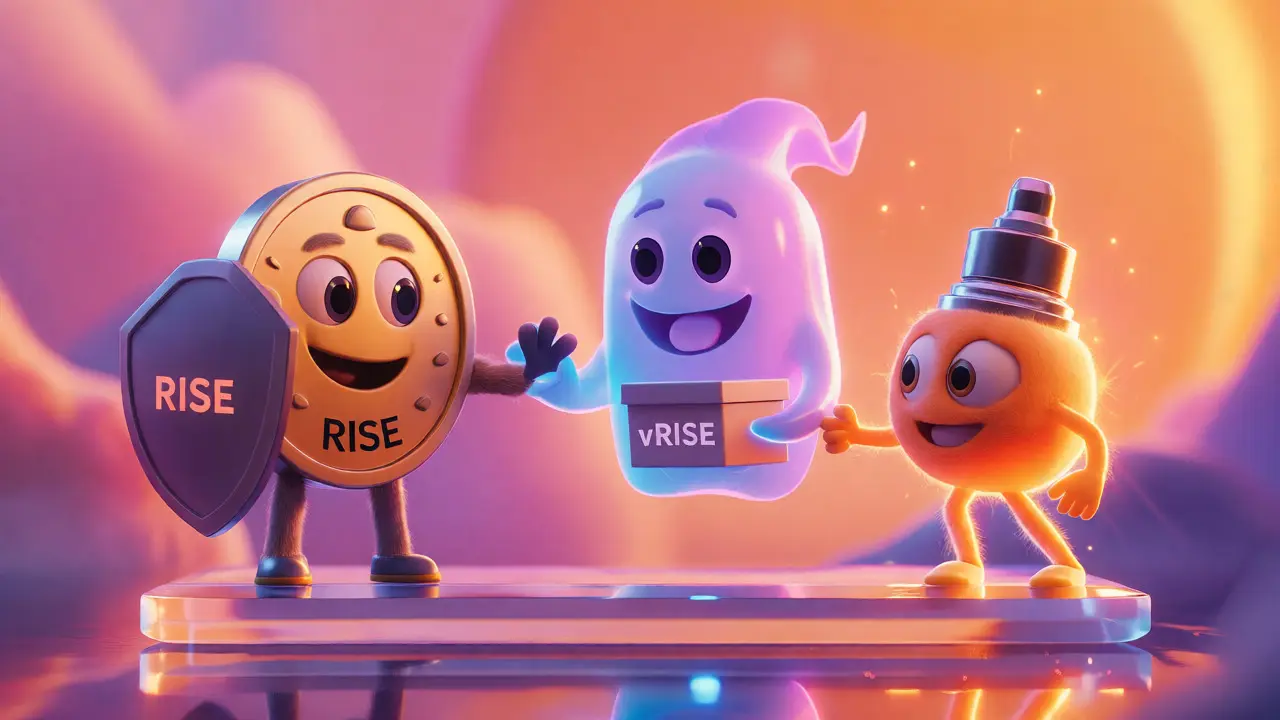
If you try to buy "Sunrise," you’ll quickly realize there isn’t just one token. There are three, and they do very different jobs. Confusing them is the easiest way to lose money or misunderstand governance rights.
| Token | Type | Primary Function | Governance Rights? |
|---|---|---|---|
| RISE | Transferable Asset | Consensus staking, value accrual, trading on exchanges. | No |
| vRISE | Non-Transferable Utility | Obtained by providing liquidity. Used for voting on protocol parameters. | Yes |
| USDrise | Gas Token | Pays for on-chain transaction fees. Can be swapped from other tokens via fee abstraction. | No |
Here is why this structure matters. Most blockchains let you buy governance rights. You buy the token, you vote. In Sunrise, governance is tied to vRISE. You cannot simply buy vRISE on an exchange because it is non-transferable. You earn it by providing liquidity to designated pools. This ensures that only active participants who contribute capital to the network get a say in how the network runs. It’s designed to keep speculators out of the boardroom.
Meanwhile, RISE is the transferable token you see on price charts. It is used for staking to secure the network but grants no voting power. And USDrise handles gas fees. But here’s the clever bit: you don’t necessarily need USDrise to pay for gas. Through fee abstraction, you can pay in any supported token. The protocol automatically swaps your payment into USDrise, then burns 50% of that USDrise by swapping it into RISE and destroying it. This creates constant deflationary pressure on RISE whenever people transact.

Tokenomics: Supply, Sale, and the "Zero Circulating" Mystery
If you check CoinMarketCap or CoinGecko today, you might see a circulating supply of 0 RISE and a market cap of $0. Does that mean the project is dead? No. It means the token generation event (TGE) and vesting schedules are still playing out, or the trackers haven’t updated their circulating supply calculations correctly yet.
Here are the hard facts based on official documentation and sale data:
- Total Supply Cap: Documentation cites a max supply of 1,000,000,000 RISE.
- Minted Supply: Currently, approximately 500,000,000 RISE are minted.
- Community Sale: Ran from June 3 to June 13, 2025. Sold 25 million RISE (5% of total supply) at $0.08 USD per token, raising ~$3 million.
- Distribution: A massive 65.5% of the supply is allocated to ecosystem incentives (airdrops, community contributors, liquidity bootstrapping). Only 20% goes to the team and 14.5% to VC investors.
This distribution ratio is significant. With nearly two-thirds of tokens going to the community and ecosystem rather than insiders, Sunrise is betting big on organic growth over venture-backed hype. However, this also means there is a lot of supply potentially hitting the market as vesting unlocks occur. Early buyers at $0.08 are currently looking at prices hovering between $0.00019 and $0.0023 in mid-to-late 2026. That’s a steep drop, typical for early-stage infrastructure projects before full utility kicks in.
How Proof-of-Liquidity Actually Works Here
Berachain made Proof-of-Liquidity famous, and Sunrise adapts it for a Data Availability context. In traditional Proof-of-Stake, validators lock up tokens to propose blocks. In Sunrise’s PoL, the security of the network is linked to the depth of liquidity in its pools.
When you provide liquidity to a Sunrise pool, you receive vRISE. This vRISE represents your stake in the network’s economic health. Validators and nodes that support these liquidity-heavy environments are rewarded with RISE emissions. This aligns incentives: if the liquidity pools dry up, the network becomes less secure and rewards drop. If liquidity flows in, the network strengthens. For rollups, this is attractive because they can rely on Sunrise’s pre-existing liquidity rather than begging users to bridge funds to their specific chain.
Technically, Sunrise maintains compatibility with Celestia-style architectures. This means it can handle blob-like data submissions efficiently. But unlike Celestia, which is purely a DA layer, Sunrise integrates the financial layer directly. You aren’t just submitting data; you are interacting with a live financial market on the same base layer.
Risks and Realities: What Could Go Wrong?
No crypto project is without risk, and Sunrise has several red flags worth watching.
Complexity Barrier: Managing three tokens and understanding fee abstraction is harder than just holding ETH. Users must understand that paying gas involves automatic swaps and burns. If you send the wrong token to a contract expecting RISE, you might face unexpected swap rates or failed transactions.
Adoption Uncertainty: As of late 2026, there is limited public data on the number of rollups actively using Sunrise for DA. Without significant Total Value Locked (TVL) or daily active users, the "shared liquidity" thesis remains theoretical. Competitors like Celestia and EigenLayer already have established ecosystems. Sunrise needs to prove its PoL model attracts more capital than pure stake-based models.
Price Volatility: The drop from $0.08 to sub-cent levels indicates heavy selling pressure or low initial demand. While the burn mechanism helps long-term, short-term traders face high volatility. The lack of a clear circulating supply figure on some trackers adds confusion, making it hard to gauge true market depth.
Getting Started: How to Engage with Sunrise
If you believe in the thesis, how do you participate? It’s not just about buying RISE.
- Acquire RISE: Buy on supported exchanges. Note that liquidity may be thin compared to major caps.
- Provide Liquidity: To get governance rights, you must deposit assets into designated Sunrise pools. This earns you vRISE.
- Stake RISE: Lock RISE to help secure the network and earn consensus rewards.
- Vote: Use your earned vRISE to vote on AMM fee rates and incentive distributions. Remember, vRISE is non-transferable, so you can’t sell your vote.
For developers, integrating with Sunrise requires familiarity with its specific SDKs for DA submission and its fee abstraction logic. You’ll need to handle the micro-denomination of urise (1 RISE = 1,000,000 urise) carefully to avoid rounding errors in smart contracts.
Is Sunrise (RISE) the same as Berachain?
No, but they share DNA. Sunrise extends Berachain's Proof-of-Liquidity model but focuses specifically on being a Data Availability layer and liquidity hub for rollups, whereas Berachain is a general-purpose Layer 1 blockchain.
Why is the circulating supply of RISE showing as zero?
This is likely due to ongoing vesting schedules following the June 2025 sale or delays in tracker updates. While tokens are traded, the fully diluted circulating count hasn't been finalized or recognized by all aggregators yet.
Can I vote on Sunrise proposals with just RISE?
No. Governance rights are held by vRISE, which is non-transferable and earned only by providing liquidity to Sunrise pools. Holding RISE allows for staking rewards but not governance voting.
What happens to the gas fees paid in USDrise?
50% of the USDrise used for fees is swapped into RISE and burned. This creates a deflationary mechanism for the RISE token, reducing its total supply over time as network usage increases.
Is Sunrise compatible with Ethereum?
Yes, Sunrise is designed to serve as a Data Availability layer for Ethereum rollups, allowing them to post data to Sunrise instead of Ethereum L1, potentially reducing costs while accessing Sunrise's shared liquidity.