





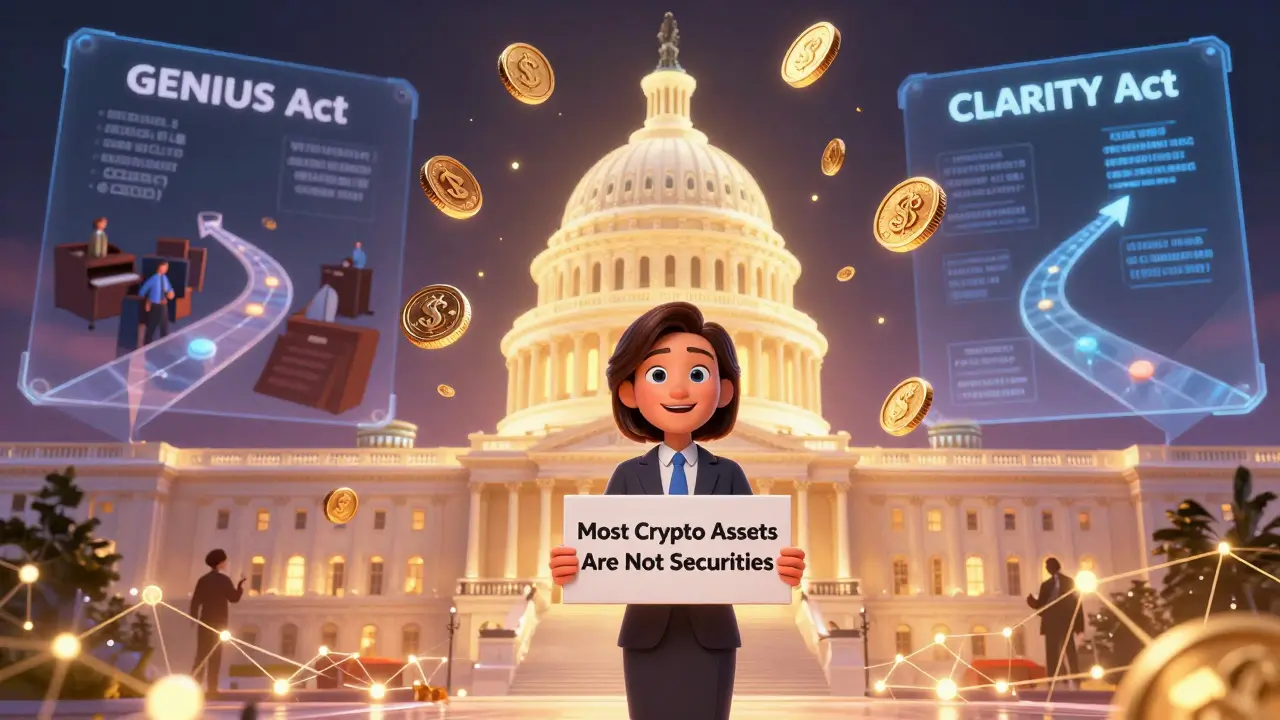
For years, crypto companies in the U.S. operated in the dark. The SEC sued exchanges, labeled tokens as securities without clear rules, and left developers guessing whether their project was legal. That changed in 2025. The crypto securities law landscape didn’t just shift-it was rebuilt from the ground up.
The Breakthrough: Crypto Week and the GENIUS Act
July 18, 2025, was the day U.S. crypto regulation stopped being a guessing game. Congress passed three major bills in one week-dubbed "Crypto Week"-and the President signed the GENIUS Act (Guiding and Establishing National Innovation for US Stablecoins Act) into law. For the first time, there was a federal law specifically designed to regulate stablecoins. It gave issuers clear rules: register with the Treasury, hold reserves in cash or short-term Treasuries, and disclose daily redemption rights. No more Terra-style collapses hiding behind vague promises. The CLARITY Act (Digital Asset Market Clarity Act of 2025) followed right behind. It didn’t just clarify-it redefined. The bill established a legal framework to determine when a digital asset is a security and when it isn’t. It said outright: if a token is used primarily for utility on a decentralized network, it’s not a security. That’s a massive shift from the SEC’s old stance, where almost anything with a price tag got slapped with a securities label.SEC’s Project Crypto: A Complete Reversal
The biggest surprise came on July 31, 2025. SEC Chair Paul Atkins stood in front of the America First Policy Institute and said something unthinkable just a year earlier: "Most crypto assets are not securities." That wasn’t a slip of the tongue. It was the opening line of Project Crypto (SEC’s comprehensive initiative to modernize securities laws for digital assets). For the first time, the SEC admitted its past approach had failed. The Howey test-designed in 1946 for orange groves and investment contracts-wasn’t built for blockchain. So the SEC scrapped the blanket enforcement strategy. Instead, it launched a rulemaking process to create new, crypto-specific rules. Project Crypto gave clear guidance: if a token is distributed in a way that doesn’t rely on the efforts of a central team to create value-if users are buying it to use the network, not to bet on someone else’s success-it’s not a security. Airdrops? Safe. Staking rewards? Legal if they’re network incentives, not profit-sharing schemes. Initial coin offerings? They can now follow a new, streamlined disclosure path instead of being treated like penny stock scams. The SEC also moved to protect self-custody. No more forcing users to hand over private keys to regulated intermediaries. People can now hold their own crypto without triggering securities laws. That’s huge. It means decentralized finance isn’t just tolerated-it’s legally recognized as a legitimate financial infrastructure.State Regulators Push Back-But Can’t Stop the Wave
Not everyone cheered. State securities regulators, organized under NASAA, warned Congress that the CLARITY Act might weaken their power. They argued that if the federal government defines "investment contract" too narrowly, fraudsters could slip through the cracks. They’ve filed comments, held hearings, and even threatened to sue if federal rules leave gaps. But their concerns are fading. In 2025, state regulators brought fewer crypto fraud cases than in any year since 2017. Why? Because the federal rules are finally clear. When the SEC says a token isn’t a security, state agencies can’t override that. And when they try, federal courts side with the new law. The days of state regulators chasing Bitcoin miners or Ethereum stakers are over.
How the Howey Test Died-And What Replaced It
The Howey test used to be the only tool the SEC had to decide if a crypto token was a security. It looked at four things: investment of money, common enterprise, expectation of profit, and reliance on others’ efforts. But in crypto, those lines blur. A person buys Solana to pay for apps on its network. Is that an investment? Or just a purchase? The CLARITY Act replaced the Howey test with a three-part test for digital assets:- Is the asset primarily used to access or interact with a decentralized network?
- Was it distributed without promises of profit or returns?
- Is the network’s development decentralized and open-source, with no central team controlling its future?
Banking and Crypto Finally Talk to Each Other
Before 2025, banks refused to touch crypto. Regulators didn’t give them clear rules, so they played it safe. Now, the Federal Reserve, OCC, and FDIC jointly issued guidance allowing federally chartered banks to offer crypto custody services. They don’t have to hold the keys for clients-they can use third-party custodians approved by the SEC. They can even offer staking services, as long as they disclose risks and don’t promise returns. JPMorgan, Wells Fargo, and Bank of America all rolled out crypto custody services by October 2025. Not because they love Bitcoin. But because the law now says they can. This integration is the real win. Crypto isn’t a parallel system anymore. It’s part of the financial backbone.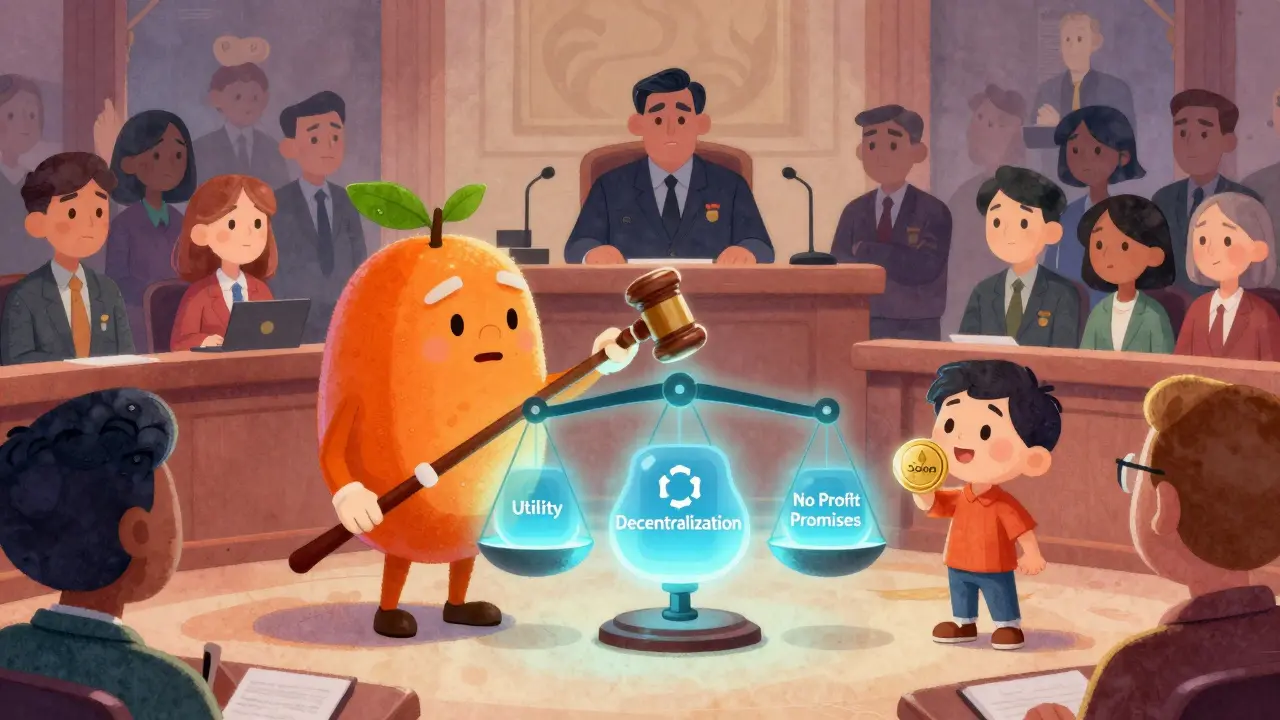
What’s Still Unclear?
The big picture is clear. But details are still being worked out. The CLARITY Act hasn’t passed the Senate yet. The SEC’s rulemaking process will take months. Some questions remain:- How will decentralized autonomous organizations (DAOs) be treated under securities law? Are they legal entities? Can they issue tokens?
- What happens to tokens that started as securities but became decentralized over time? Do they get grandfathered in?
- Will the SEC still pursue past cases, like the one against Coinbase, or will they drop them now that the rules have changed?
What This Means for You
If you’re a developer building a blockchain app: you can now launch a token without hiring a team of lawyers just to avoid an SEC lawsuit. If you’re an investor: you can buy tokens knowing whether they’re regulated as securities or not. If you’re a bank: you can offer crypto services without risking your charter. The U.S. didn’t just catch up to Europe or Singapore in crypto regulation. It led. By 2025, the world looked to Washington-not just for financial power, but for legal clarity. And that’s the real future of crypto securities law: not bans, not chaos, but rules that work.Are all crypto tokens now legal in the U.S.?
No. Only tokens that meet the new criteria under the CLARITY Act are exempt from securities laws. Tokens sold with promises of profit, controlled by a central team, or designed as investments still count as securities and must comply with SEC rules. Fraud, scams, and unregistered offerings are still illegal.
Can I still be sued by the SEC for past crypto activity?
Possibly. The SEC hasn’t dropped all past enforcement cases, but they’ve signaled they’ll prioritize new violations under the updated rules. If your project was shut down in 2023 for being a security, and you’ve since decentralized it, you may be able to reapply under the new framework. Legal counsel is still recommended.
Does this mean crypto is now a safe investment?
No. Legal doesn’t mean safe. Tokens can still crash, projects can still fail, and scams still exist. The new laws protect against fraud and unregistered securities-not against market risk. Always do your own research, even if something is legally compliant.
What’s the difference between the GENIUS Act and the CLARITY Act?
The GENIUS Act regulates stablecoins-digital dollars backed by cash or Treasuries. The CLARITY Act defines which other digital assets are securities and which aren’t. One is about money; the other is about property rights and investment classification.
Will other countries follow the U.S. lead?
Already are. The EU’s MiCA regulation, Canada’s approach, and Japan’s revised financial laws now mirror key parts of the 2025 U.S. framework. Global regulators are shifting from bans to clarity. The U.S. didn’t invent this model-but it accelerated it.


Write a comment