





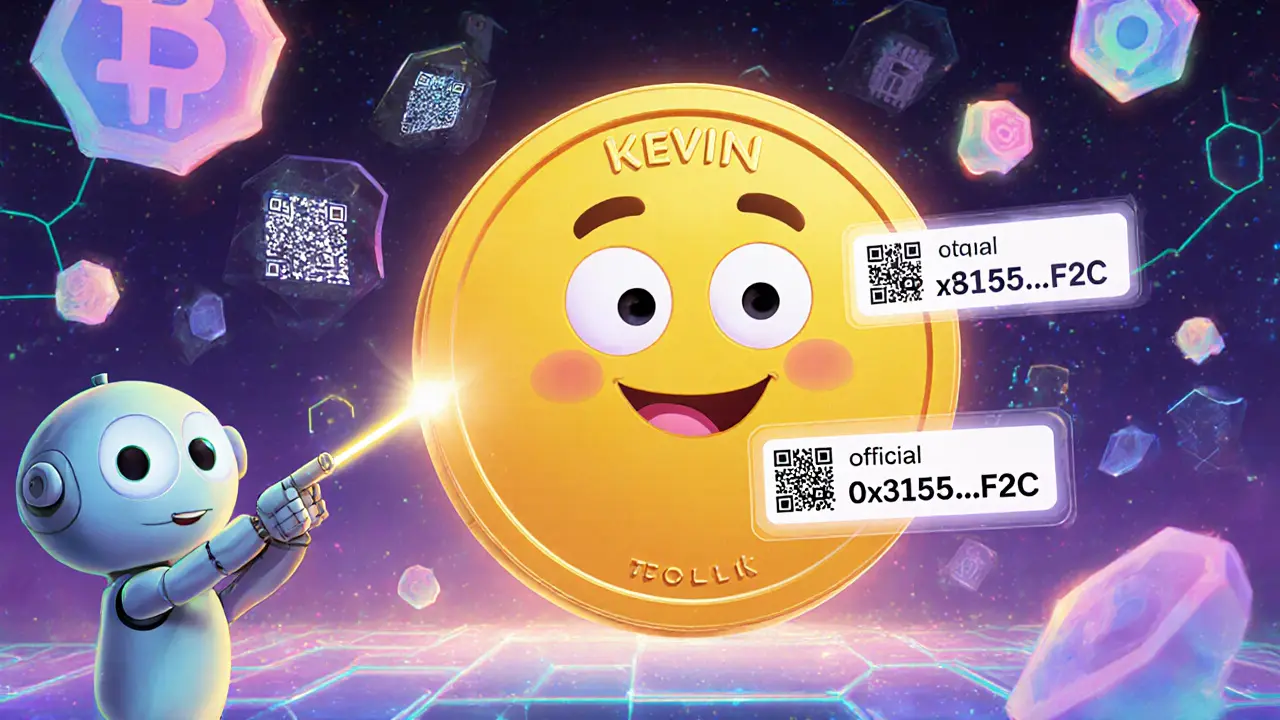
KEVIN Crypto Token Checker
Verify if the KEVIN token details you've received match the official information to protect yourself from scams.
Ever stumbled upon a token called KEVIN and wondered if it’s worth a glance? You’re not alone. Since its launch in 2023, this memecoin has sparked a mix of curiosity and confusion, especially with mixed reports about its blockchain home and supply numbers. This guide pulls together the most reliable data, clears up the biggest myths, and shows you exactly how you can interact with KEVIN today.
Quick Facts
- Launched: 2023 as a community‑driven memecoin
- Primary claim: "Resist the flooding of Memecoin"
- Reported blockchains: Ethereum (ERC‑20) and Solana
- Total supply figures: 690billion (Ethereum view) vs 1billion (alternative reports)
- Current price (mid‑Sept2025): roughly $0.00007 per token
What Is KEVIN?
KEVIN is a community‑driven memecoin launched in 2023 with the mission to "resist the flooding of Memecoin" in the crypto space. The token positions itself as the KEVIN crypto coin for meme enthusiasts who want a token without pre‑mining, ICOs, or private sales. In practice, KEVIN is a decentralized cryptocurrency-no single entity controls it, and its smart contract is renounced, meaning the code can’t be altered after deployment.
Unlike utility tokens that promise a specific service, KEVIN leans heavily on community sentiment. Think of it as the digital version of a quirky club where membership is simply holding the token.
Technical Specs & The Blockchain Confusion
One of the biggest hurdles for newcomers is figuring out which blockchain KEVIN lives on. Different data aggregators tell different stories.
Ethereum is a public, permissionless blockchain that introduced the ERC‑20 token standard, enabling tokens like KEVIN to be created and transferred with smart contracts. Coinbase lists KEVIN on Ethereum with contract address 0x31555696dD1242B2AB67B9a53b6465c814502F2C and a total supply of 690billion tokens.
Solana is a high‑throughput blockchain known for low transaction fees and fast finality. Some explorers, such as CoinSwitch, claim KEVIN is a Solana‑based token, but no official contract address is widely published.
To add another layer, the token follows the ERC‑20 standard, which defines a common set of functions for tokens on Ethereum. If KEVIN truly lives on Solana, it would need a different token standard (like SPL). The discrepancy likely points to either multiple tokens sharing the “KEVIN” ticker or simply data‑entry errors on aggregators.

Tokenomics & Market Data
KEVIN’s tokenomics are deliberately simple:
- No tax on transfers (0% fee)
- Liquidity pool locked permanently and burned
- Contract ownership renounced, so no central authority can change parameters
Because of the renounced contract, the token’s supply cannot be minted or burned beyond the initial allocation.
Market capitalization hovers around $100K, with reports ranging from $105K (CoinMarketCap) to $131K (CoinGecko). The tiny cap reflects both the low price per token and the modest holder count-about 1.36K wallets according to CoinMarketCap.
Price volatility is extreme, a hallmark of memecoins. On 30Sept2025, CoinGecko listed KEVIN at $0.00006971, up 2.92% in the last 24hours, while Crypto.com showed a price of $0.0000001556, down 0.40%. Trading volume is irregular: some platforms report zero daily volume, others show a few thousand dollars. Low liquidity means even small trades can move the price dramatically.
All‑time high: $0.00000109 (≈$0.00109per1K tokens). Current price sits well below that, indicating a decline of roughly 18% from the peak.
How to Buy, Store, and Transfer KEVIN
Assuming you’ve decided KEVIN is worth a look, here’s the practical checklist.
- Choose the right wallet: For Ethereum‑based KEVIN, any ERC‑20 compatible wallet works-MetaMask, Trust Wallet, or hardware wallets like Ledger. If you discover a Solana version, you’ll need a Solana‑compatible wallet such as Phantom.
- Acquire native blockchain tokens: You’ll need ETH (for Ethereum) or SOL (for Solana) to cover gas fees. KEVIN itself does not pay for transaction costs.
- Find a trading venue: KEVIN is listed on a few decentralized exchanges (DEXs) like Uniswap (Ethereum) and possibly Raydium (Solana). Centralized exchanges rarely support it; Crypto.com even notes the token is not tradable on their platform.
- Swap for KEVIN: On a DEX, connect your wallet, select the token pair (e.g., ETH/KEVIN), set the amount, and confirm the trade. Double‑check the contract address to avoid scams.
- Secure your tokens: After purchase, keep KEVIN in a wallet you control. Do not leave large balances on exchange interfaces.
Because liquidity is thin, you may encounter slippage-your trade price shifts unfavorably as the order executes. Adjust the slippage tolerance or split your order into smaller chunks.
Community, Risks, and Why It Matters
KEVIN’s community is small but vocal. Most chatter lives on Reddit and a handful of Discord servers where members share the token contract, price alerts, and memes. No major influencers have endorsed it, and professional analysts from Messari, CoinDesk, or Bloomberg have not published in‑depth reports.
Key risks to keep in mind:
- Liquidity risk: Low trading volume can make it hard to exit positions without hurting the price.
- Data inconsistency: Conflicting reports about the underlying blockchain could lead to sending tokens to the wrong network.
- Regulatory exposure: Memecoins often attract scrutiny for potential pump‑and‑dump schemes.
- Community dependency: The token’s value rests entirely on community enthusiasm; a drop in interest can cause rapid price collapse.
That said, the token’s transparent, renounced contract does provide a baseline of trust-no hidden minting function can suddenly inflate supply.
Future Outlook
Without a clear roadmap, KEVIN’s future hinges on two factors: community growth and exchange listings. If the team (or rather, the community) can secure listings on larger DEX aggregators or even a niche centralized exchange, liquidity could improve. Conversely, if the meme hype fades, the token may drift into obscurity.
Watch for any announcements about:
- New partnerships or meme campaigns that could drive social virality
- Technical upgrades, such as a bridge to another blockchain to resolve the Ethereum‑Solana ambiguity
- Liquidity pool audits that confirm the locked status
Until then, treat KEVIN as a high‑risk, speculative asset-fun to explore but not a cornerstone of a diversified crypto portfolio.
Frequently Asked Questions
Is KEVIN an ERC‑20 token or a Solana token?
The majority of reputable sources list KEVIN as an ERC‑20 token on Ethereum, with a known contract address. Some platforms mistakenly label it as a Solana token, likely due to data entry errors or a separate project using the same name.
How can I verify I’m buying the real KEVIN token?
Always compare the contract address you’re interacting with against the official address 0x31555696dD1242B2AB67B9a53b6465c814502F2C on Etherscan. If a DEX shows a different address, it’s likely a scam or a different token altogether.
What wallets support KEVIN?
Any wallet that supports ERC‑20 tokens-MetaMask, Trust Wallet, Ledger, or Coinbase Wallet-will work for the Ethereum version. If a Solana version emerges, you’ll need a Solana‑compatible wallet such as Phantom.
Is there any tax or fee when transferring KEVIN?
The token contract specifies a 0% transfer tax, so you won’t pay a fee to the token itself. You will still pay network gas fees (ETH or SOL) for the underlying blockchain transaction.
Where can I trade KEVIN?
Currently KEVIN is available on decentralized exchanges like Uniswap (Ethereum). It is not listed on major centralized platforms such as Binance or Crypto.com.


Write a comment