





You have probably noticed that holding stablecoins like USDT or USDC feels a bit boring. You keep your value safe from Bitcoin’s wild swings, but you also sit on the sidelines while your money sits idle. That is where sUSD1+ comes in. It is not just another crypto coin; it is a receipt for a professionally managed fund that works to grow your capital while keeping it backed by real-world assets.
If you are wondering what this token actually does, how it makes money, and whether it is safe enough for your portfolio, you are in the right place. We will break down the mechanics of Lorenzo staked USD1+, which is a non-rebasing share token representing ownership in the USD1+ On-Chain Tokenized Fund without using confusing jargon.
What Exactly Is sUSD1+?
At its core, sUSD1+ is a digital certificate. When you buy it, you are not buying a speculative coin that hopes to go up in price because people think it is cool. Instead, you are buying a share in the USD1+ On-Chain Tokenized Fund (OTF), an institutional-grade asset management product developed by Lorenzo Protocol.
Think of it like a mutual fund at a traditional bank, but with two major differences: it lives entirely on the blockchain, and it updates its value in real-time. The underlying currency is USD1, a stablecoin issued by World Liberty Financial backed 1:1 by U.S. dollars and Treasury securities. This means the base layer of your investment is as stable as cash.
The "s" in sUSD1+ stands for "staked." But unlike some other staking tokens that change the number of coins you hold every day (called rebasing), sUSD1+ is non-rebasing. If you deposit $100 worth of stablecoins, you get exactly 100 sUSD1+ tokens. Your balance stays at 100. What changes is the value of each token. As the fund earns interest, each sUSD1+ token becomes worth more than $1. This makes tracking your profit much simpler-you don't have to worry about your wallet balance shifting around due to algorithmic adjustments.
How Does sUSD1+ Generate Yield?
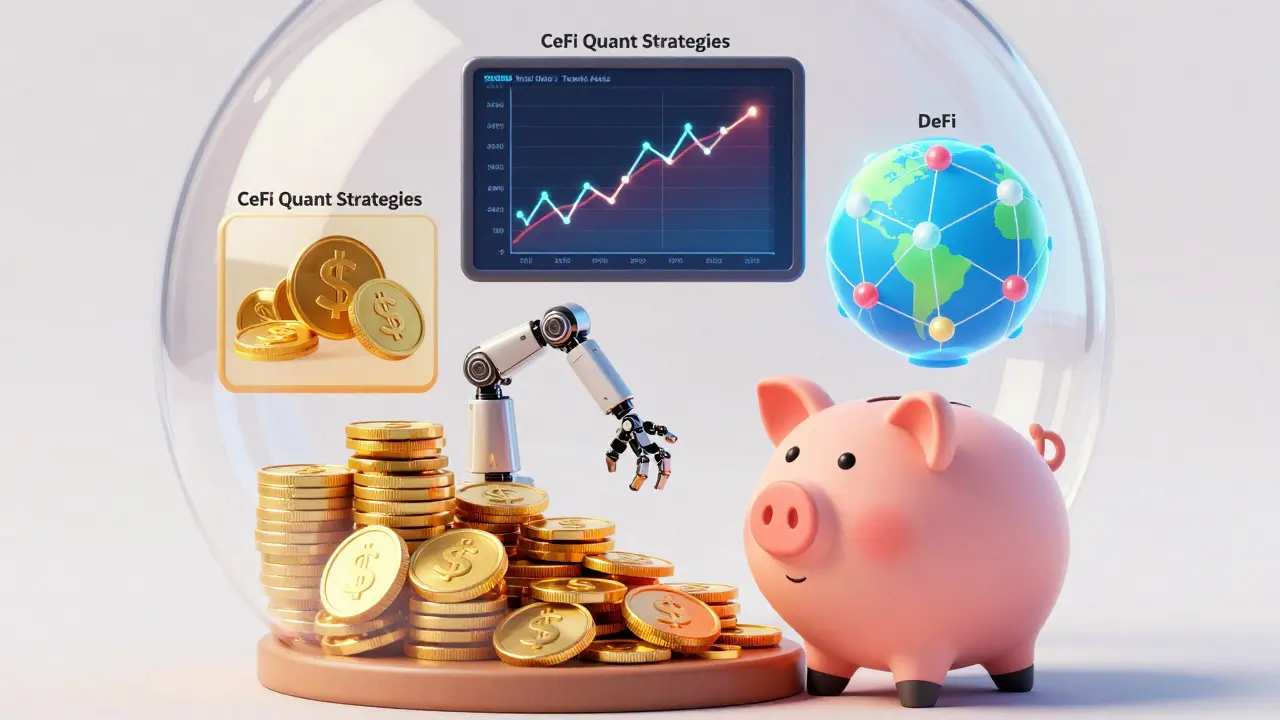
This is the part that matters most to your wallet. How does this fund actually make money? Lorenzo Protocol uses a strategy called a triple-source yield engine. Instead of putting all your eggs in one basket, they split the fund into three distinct buckets:
- Real-World Assets (RWAs) (40-50%): A large chunk of the fund is invested in tokenized U.S. Treasury bills and private credit instruments. These are low-risk, government-backed or corporate-backed loans that pay steady interest.
- CeFi Quant Strategies (30-40%): Professional trading desks use algorithms to find arbitrage opportunities and trade volatility in centralized finance markets. This is where the higher returns come from, but it also introduces more complexity.
- DeFi Protocols (20-30%): The rest goes into decentralized finance platforms for liquidity mining and lending. This captures the native yields of the crypto ecosystem.
By mixing these three sources, Lorenzo aims to smooth out the bumps. If DeFi yields drop, the Treasury bills might still be paying well. If central banks cut rates, the quant strategies might pick up the slack. The goal is to provide a consistent return that beats standard savings accounts without exposing you to the extreme risk of high-yield farming scams.
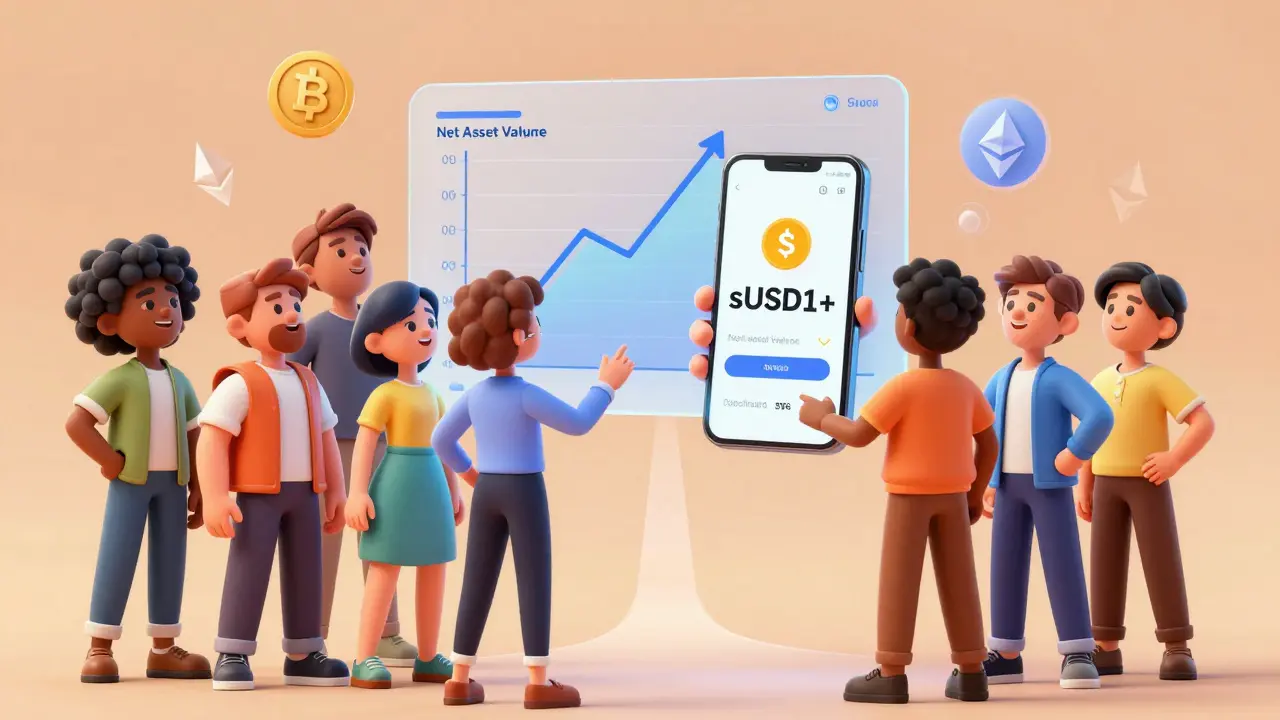
The Net Asset Value (NAV) of the fund is calculated on-chain through smart contracts. This happens at least once a day. You can see exactly how much your sUSD1+ tokens are worth at any moment, thanks to integrations with data providers like TaggerAI.
sUSD1+ vs. Traditional Stablecoins and Other Tokens
To understand why someone would choose sUSD1+, we need to compare it to what else is out there. Here is how it stacks up against common alternatives:
| Feature | Standard Stablecoins (USDT/USDC) | Single-Protocol DeFi (Aave/Curve) | sUSD1+ (Lorenzo) |
|---|---|---|---|
| Yield Source | None (Static) | Single Protocol (e.g., Lending) | Diversified (RWA + CeFi + DeFi) |
| Target APY | 0% | 2-5% (Variable) | 6-8% (Targeted) |
| Risk Profile | Low (Counterparty only) | Medium-High (Smart Contract Risk) | Medium (Diversified but Complex) |
| Minimum Investment | $0.01 | $0.01 | $1 |
| Transparency | Reserves Audited Quarterly | On-Chain Real-Time | On-Chain Daily NAV Updates |
Notice the difference in transparency. Traditional money market funds often take days to calculate their yield. sUSD1+ updates its valuation daily on the blockchain. Also, while pure RWA tokens like Ondo Finance's USDY offer good safety, they usually cap out around 5% APY because they only invest in Treasuries. sUSD1+ aims higher by adding those quant and DeFi layers.
Is sUSD1+ Safe? Understanding the Risks
No investment is free of risk, and it is crucial to look past the marketing hype. While Lorenzo Protocol has undergone security audits by firms like PeckShield and CertiK, there are specific risks you should know about before depositing funds.
- Counterparty Risk in CeFi: The 30-40% allocation to centralized quant strategies means your money is partially handled by off-chain traders. If that desk fails or acts maliciously, it could impact the fund. This is the "black box" concern raised by some critics.
- Smart Contract Risk: Like all DeFi products, if there is a bug in the sUSD1+ code or the underlying USD1 contract, funds could be vulnerable to exploits. Regular audits help mitigate this, but they do not eliminate it entirely.
- Regulatory Uncertainty: Because sUSD1+ represents a share in a fund, regulators might view it as a security. Lorenzo is working with legal firm Perkins Coie to ensure compliance, but laws in the U.S. and Europe are still evolving regarding tokenized assets.
- Stablecoin Peg Risk: The entire system relies on USD1 maintaining its $1 peg. If World Liberty Financial faces issues, the value of your sUSD1+ could drop regardless of the yield earned.
For most users, the risk is manageable if you treat this as a medium-term holding rather than a place to park your life savings. It is safer than chasing 100% APY farms, but riskier than keeping cash in a FDIC-insured bank account.
How to Buy and Use sUSD1+
Getting started with sUSD1+ is straightforward if you already have a crypto wallet. Currently, the token is primarily deployed on BNB Chain, though plans exist to expand to Ethereum and Solana later in 2024.
Here is the step-by-step process:
- Set Up Your Wallet: Ensure you have a compatible wallet like MetaMask or Trust Wallet configured for BNB Chain.
- Acquire Stablecoins: Buy USD1, USDT, or USDC. Lorenzo allows deposits in these major stablecoins.
- Navigate to Lorenzo Protocol: Go to the official Lorenzo interface. Be careful to verify the URL to avoid phishing sites.
- Deposit Funds: Connect your wallet and select the amount of stablecoins you want to convert. The system will automatically swap them for sUSD1+ tokens.
- Monitor Your NAV: You can track the growth of your position directly in your wallet or via third-party dashboards like TaggerAI.
New users might find the initial setup slightly complex, especially if they need to bridge assets between chains. Lorenzo has simplified this by adding automatic conversion features, but expect the first transaction to take about 10-15 minutes as you learn the flow. Experienced DeFi users will likely be done in under five minutes.
The Future of Lorenzo and sUSD1+
Lorenzo Protocol is not stopping with just one product. They recently launched BNB+, another tokenized fund with a quadruple yield engine, and introduced Lorenzo Earn for additional yield layers. Their roadmap includes expanding to multi-chain environments and integrating with Babylon for Bitcoin restaking capabilities.
The broader market for tokenized real-world assets is booming. Reports from Consensys show the sector growing by over 300% in recent years. Institutions are looking for ways to bring traditional yield onto the blockchain, and sUSD1+ is positioned to capture a significant slice of that demand. If you believe in the convergence of TradFi and DeFi, sUSD1+ offers a practical way to participate today.
What is the minimum amount to invest in sUSD1+?
The minimum investment is very low, starting at just $1. This makes it accessible for retail investors who cannot meet the $1,000-$3,000 minimums often required by institutional money market funds.
Does sUSD1+ rebase my token balance?
No, sUSD1+ is a non-rebasing token. The number of tokens in your wallet remains constant. Instead, the value of each individual token increases as the fund generates yield, making it easier to track your profits.
Which blockchain is sUSD1+ on?
Currently, sUSD1+ is deployed on BNB Chain. Lorenzo Protocol has announced plans to expand to Ethereum and Solana networks in the future to increase accessibility and liquidity.
Is sUSD1+ regulated?
Lorenzo Protocol is working with legal experts to ensure compliance with U.S. securities laws and stablecoin regulations. However, as with all DeFi products, regulatory landscapes are shifting, and users should stay informed about local laws.
How often is the yield updated?
The Net Asset Value (NAV) is updated on-chain at least once daily. This provides near-real-time visibility into the performance of your investment, unlike traditional funds that may report yields weekly.


Write a comment