






If you’ve seen ads for Bitrecife promising instant crypto profits with zero effort, you’re not alone. Social media feeds are flooded with fake videos of Elon Musk and Warren Buffett endorsing it. The website looks polished. The interface is clean. The promises? Too good to be true. And that’s exactly how scams work.
Bitrecife Claims It’s a Crypto Exchange. Here’s What It Really Is
Bitrecife.com says it’s a crypto exchange where you can buy Bitcoin, Ethereum, and other coins with low fees and guaranteed returns. But there’s no real trading happening. No order books. No liquidity. No market makers. Just a fake dashboard showing your balance going up - until you try to withdraw. This isn’t a platform. It’s a digital trap. The whole thing is designed to look like a legitimate exchange, but every feature is a lie. The ‘trading system’? A script that simulates profits. The ‘customer support’? Chatbots that vanish when you ask for proof of funds. The ‘secure platform’? No SSL validation, no two-factor authentication, and no public audit records.Red Flags That Prove Bitrecife Is a Scam
Legitimate crypto exchanges don’t hide. They publish their company registration, physical offices, and regulatory licenses. Bitrecife does none of that. Here’s what’s missing:- No registration with the FCA, SEC, or ASIC - the top financial regulators in the US, UK, and Australia.
- No physical address. The domain is registered privately through NameSilo, a common tactic for fraudsters.
- No proof of reserves. Unlike Kraken or Coinbase, which publish monthly audits, Bitrecife offers zero financial transparency.
- No API documentation. Real exchanges let developers connect tools. Bitrecife doesn’t even have a developer page.
- Claims of ‘guaranteed profits’ - a direct violation of how markets work. No one can guarantee returns in crypto.
How the Scam Works: The ‘Pig Butchering’ Method
Bitrecife uses a scam technique called ‘pig butchering’ - named because scammers ‘fatten up’ victims before slaughtering them. Here’s the step-by-step:- You’re contacted on Instagram, Facebook, or Telegram by someone who seems friendly - often with fake profiles and stolen photos.
- They send you to Bitrecife, where you deposit $100. Within hours, your balance jumps to $150. You think you’ve found a goldmine.
- You deposit more - $500, then $1,000. Your dashboard shows $2,000, $5,000, even $10,000.
- When you try to cash out, they say your account needs ‘verification.’ You’re asked to pay a fee - $200, $500, $1,000 - to unlock your funds.
- You pay. Then they ask for another fee. And another. Eventually, you’re blocked. The chat disappears. The website may still load, but your money is gone.
Fake Reviews and Future-Dated Testimonials
Scammers know people check reviews. So they fake them. On REVIEWS.io, there’s a 2-star review dated October 3, 2025 - a date that hasn’t happened yet. The review says: ‘Reliable and secure exchange Make exchanges easily Some exchanges are commission free and great.’ That’s not a real user. That’s a bot-generated text with contradictions baked in. Trustpilot shows only two reviews. For a platform claiming global service? That’s impossible. Legitimate exchanges have thousands. Bitrecife has ghosts. The FTC flagged this exact tactic in their 2022 report: fake reviews with impossible dates are a hallmark of crypto fraud.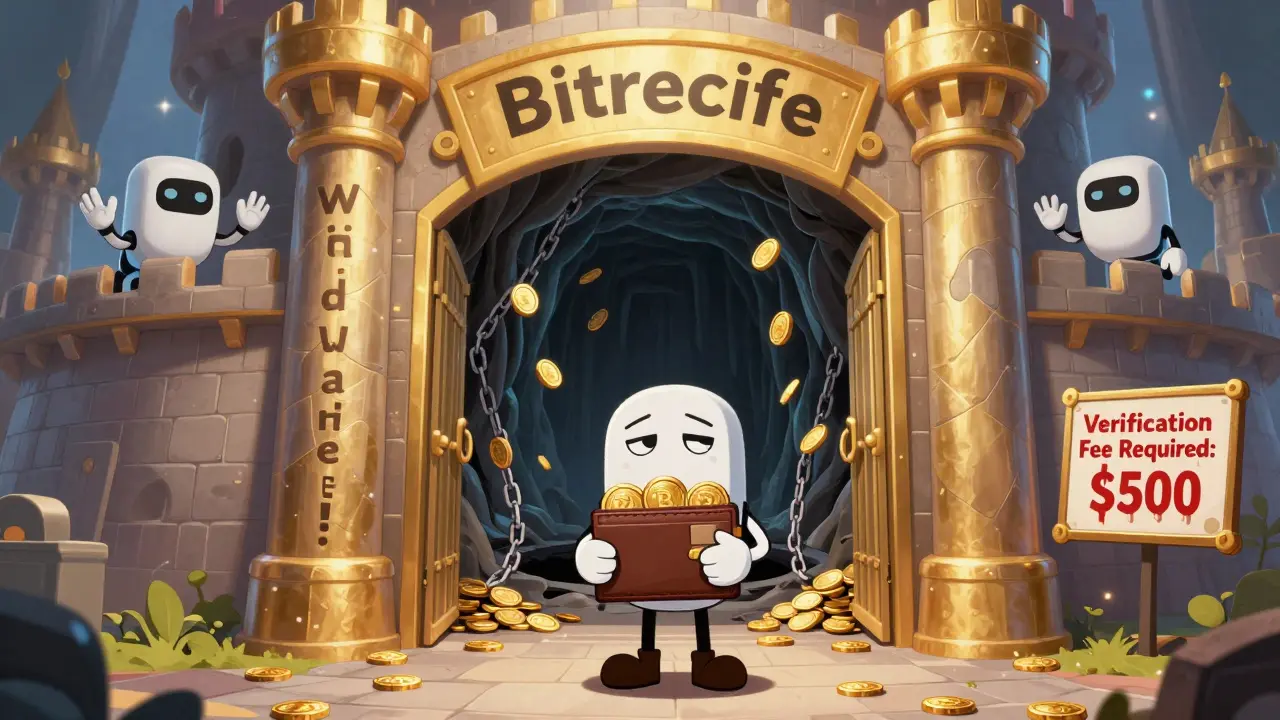
Why You Won’t Find Bitrecife on CoinGecko or CoinMarketCap
CoinGecko and CoinMarketCap are the go-to sources for checking crypto platforms. They don’t list every coin or exchange. They vet them. Bitrecife isn’t listed. Why? Because it fails every requirement: no legal entity, no compliance, no transparency, no audit trail. If it were real, it would be on those sites. The fact it’s not? That’s your first warning.What Happens When You Try to Withdraw
This is where the mask drops. Users report being blocked after deposits of $200 or more. The platform suddenly demands:- ‘KYC verification’ - but asks for your ID, passport, and selfie with a handwritten note. Legitimate exchanges don’t ask for your ID in chat.
- ‘Withdrawal fee’ - often 10-20% of your balance. Real exchanges charge a small network fee, not a percentage.
- ‘Account freeze’ - then they say you must deposit more to ‘unfreeze’ it. Classic salting technique.
Who’s Behind Bitrecife? No One Knows
No one knows who runs Bitrecife. No LinkedIn profiles. No team page. No press releases. The domain was registered on September 14, 2023 - just months before this review. The hosting IP is linked to other known scam sites that stole over $2.3 million in 2022-2023. MalwareTips.com gave it a 98% scam probability. TheSafetyReviewer called it ‘a fully engineered deception.’ TradersUnion outright said: ‘I do not recommend Bitrecife.’ There’s no mystery here. It’s a shell company built to drain accounts and vanish.
Real Alternatives to Bitrecife
If you want to trade crypto safely, use platforms that have been around for years and are regulated:- Coinbase - Founded in 2012. Licensed in the US and EU. Publicly traded. Offers insurance on holdings.
- Binance - The world’s largest exchange by volume. Has global compliance teams and audit reports.
- Kraken - Publishes monthly proof-of-reserves. Strong security track record.
- Interactive Brokers - For those who want to trade crypto alongside stocks. Rated 9.4/10 for safety.
How to Avoid Crypto Scams Like Bitrecife
Here’s how to protect yourself:- Never trust platforms that promise guaranteed returns. Crypto is volatile. No one can guarantee profits.
- Check if the exchange is listed on CoinGecko or CoinMarketCap. If it’s not, walk away.
- Search for the platform name + ‘scam’ or ‘review’ on Reddit and Trustpilot. Look for real user experiences, not fake testimonials.
- Never share your private keys or seed phrases. Legitimate exchanges never ask for them.
- If you’re pressured to act fast - ‘Limited time offer!’ - that’s a scam trigger.
- Use two-factor authentication (2FA) on every account. Never rely on SMS-only verification.
Final Verdict: Don’t Touch Bitrecife
Bitrecife isn’t a crypto exchange. It’s a scam factory. It’s built to look real, feel real, and trick you into thinking it’s real. But every layer is a lie - from the fake reviews to the impossible profits to the hidden ownership. The money you send there won’t be traded. It won’t be stored. It will be stolen. If you’ve already lost money to Bitrecife, report it to your local financial crime unit. The FBI’s IC3 and the UK’s Action Fraud both accept crypto scam reports. Recovery is rare, but reporting helps shut these operations down. There’s no shortcut to crypto wealth. Legit trading takes time, research, and patience. Bitrecife offers none of that. It only offers loss.Is Bitrecife a real crypto exchange?
No, Bitrecife is not a real crypto exchange. It’s a fraudulent platform designed to mimic legitimate services. It has no regulatory licenses, no transparent ownership, no proof of reserves, and no presence on trusted platforms like CoinGecko or CoinMarketCap. Multiple cybersecurity firms, including MalwareTips and TheSafetyReviewer, have classified it as a high-risk scam.
Can I withdraw money from Bitrecife?
Users report being blocked from withdrawing funds after depositing money. The platform typically demands additional ‘verification fees’ or ‘tax payments’ to release your balance - a classic scam tactic. Once you pay these fees, you’re usually locked out completely. No legitimate exchange charges fees to let you withdraw your own money.
Why is Bitrecife not on CoinGecko or CoinMarketCap?
CoinGecko and CoinMarketCap only list exchanges that meet strict verification standards, including legal registration, transparency, and security audits. Bitrecife fails every requirement. Its absence from these platforms is one of the clearest signs it’s a scam.
Are the reviews on Bitrecife’s website real?
No, the reviews are fake. REVIEWS.io shows a review dated October 3, 2025 - a future date that hasn’t occurred yet. Trustpilot has only two reviews, which is suspicious for a platform claiming global users. These are fabricated to build false trust. The FTC has documented this tactic as common in crypto scams.
What should I do if I already sent money to Bitrecife?
Stop sending more money immediately. Report the incident to your local financial crime authority - such as Action Fraud in the UK or the FBI’s IC3 in the US. While recovering funds is unlikely, reporting helps authorities track and shut down these operations. Also, change all your passwords and enable two-factor authentication on other crypto accounts.
How do scammers promote Bitrecife?
Scammers use fake social media ads featuring manipulated videos of celebrities like Elon Musk and Warren Buffett. These videos are edited to make it look like they’re endorsing Bitrecife. The ads run on Instagram, Facebook, and Telegram. Once users click, they’re redirected to the fake platform. Over 12,000 clicks were recorded before these ads were removed from major platforms.


Write a comment