






Think about the last time you created a new account for a service. You likely typed in your name, email, phone number, and maybe even uploaded a photo of your driver's license. Now imagine doing that again for a bank, then again for a healthcare provider, and again for a government portal. It’s repetitive, tedious, and frankly, risky. Every time you hand over that data, it sits in a centralized database-a giant target for hackers.
This is where blockchain identity authentication changes the game. Instead of relying on these fragile, centralized silos, blockchain offers a way for you to own and control your digital identity. It’s not just a buzzword; it’s a structural shift in how we verify who we are online. By moving from institutional trust to cryptographic proof, this technology solves some of the biggest headaches in modern digital life: data breaches, slow verification processes, and lack of privacy.
What Is Blockchain Identity Authentication?
To understand the benefits, we first need to strip away the hype and look at what this actually is. Traditional identity management relies on central authorities. A company like Facebook or a bank holds your data and says, "Yes, this person is who they claim to be." If their servers get hacked, your data is exposed. This model has inherent flaws because it creates single points of failure.
Blockchain Identity Authentication is a decentralized system where users maintain control over their identity data using cryptographic keys rather than relying on central authorities. It operates on the principle of Self-Sovereign Identity (SSI). In this model, you hold your credentials in a digital wallet on your device. When you need to prove something-like your age or your employment status-you share only the necessary proof without revealing your entire history.
The technical backbone involves three main components:
- Decentralized Identifiers (DIDs): Unique strings that identify you on the blockchain, standardized by the World Wide Web Consortium (W3C) in 2022.
- Verifiable Credentials: Digital documents issued by trusted entities (like a university or government) that are cryptographically signed.
- Digital Wallets: Applications on your mobile or desktop device that store your private keys and credentials.
This structure means no single company owns your identity. The blockchain acts as a public ledger to verify that a credential is valid and hasn’t been tampered with, but it doesn’t necessarily store your personal details. This distinction is crucial for privacy.
Core Benefits of Decentralized Identity
Why should you care about this shift? The advantages aren't just theoretical; they address real-world pain points that affect billions of users daily.
1. Enhanced Security and Reduced Breach Risk
Centralized databases are honey pots for cybercriminals. Remember the Equifax breach in 2017? It affected 147 million people because one company’s security failed. With blockchain identity, there is no central repository to hack. Your identity data is distributed across multiple nodes in the network. Even if an attacker compromises one node, they don’t get access to your full identity profile. Furthermore, since you control the private keys, attackers can’t steal your identity unless they physically compromise your device and bypass your biometric or password protections.
2. User Privacy Through Zero-Knowledge Proofs
One of the most powerful features of blockchain identity is the ability to prove something without revealing the underlying data. This is done through zero-knowledge proofs. For example, if a website requires you to be over 18, you don’t need to upload a scan of your passport showing your address, name, and ID number. Instead, your wallet generates a cryptographic proof that says, "This user is over 18," verified by a trusted issuer. The website gets the answer it needs without collecting unnecessary personal information. This minimizes the data footprint and reduces the risk of misuse.
3. Faster and Cheaper Verification
Traditional Know Your Customer (KYC) processes are notoriously slow. According to J.P. Morgan’s Kinexys division, traditional KYC can take 24 to 72 hours. In contrast, optimized blockchain identity systems can process 98% of verifications in under two seconds. This speed isn't just convenient; it’s cost-effective. Dock Labs reported that blockchain verification can reduce costs by 65% compared to traditional methods. For businesses, this means lower overhead and faster onboarding. For users, it means less waiting in virtual lines.
4. Interoperability Across Platforms
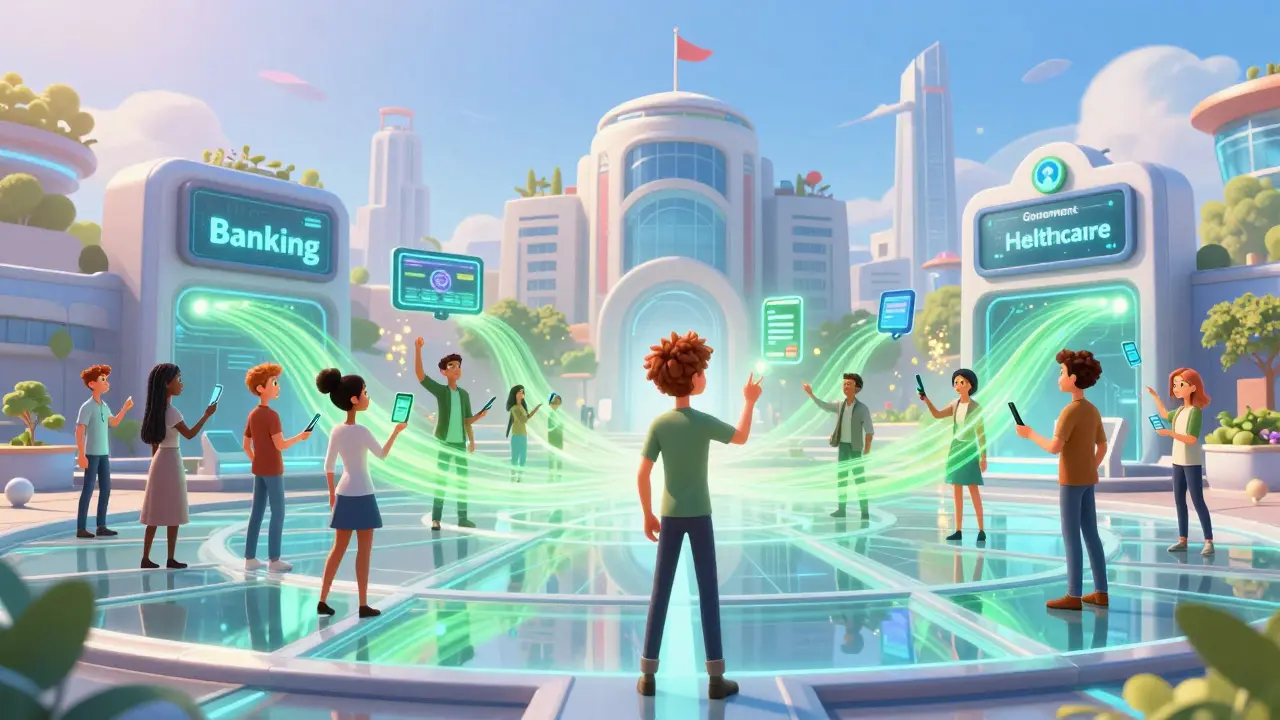
Currently, your identity on LinkedIn is separate from your identity on Twitter, which is separate from your banking app. Blockchain identity aims to unify this. Because DIDs and Verifiable Credentials follow W3C standards, a credential issued by one entity can be recognized by many others. You could theoretically use the same digital identity to log into a hospital portal, a bank, and a government service without creating new accounts each time. This eliminates the "password fatigue" that plagues internet users today.
How It Works: A Practical Example
Let’s walk through a real-world scenario to see how this functions in practice. Imagine you’re applying for a mortgage.
- Issuance: Your employer issues a digital employment certificate to your wallet. Your bank issues a credit score credential. These are cryptographically signed and stored securely on your device.
- Presentation: You apply for a mortgage with Lender A. Instead of mailing physical pay stubs or giving them access to your entire bank statement, you select the specific credentials relevant to the application.
- Verification: Lender A’s system checks the cryptographic signatures against the blockchain ledger. It confirms that the credentials were indeed issued by your employer and bank and haven’t been altered. This happens in seconds.
- Result: The lender approves your application based on verified data, and you retain control over exactly what was shared.
This process removes the friction of manual document checks and reduces the chance of fraud, as forged documents would fail the cryptographic validation.
Challenges and Limitations
While the potential is huge, blockchain identity isn’t a magic bullet. There are significant hurdles that prevent mass adoption right now.
Key Management Complexity
In a decentralized system, you are your own bank. If you lose your private key, you lose access to your identity. Unlike a traditional password reset where a support team can help you, there is no central authority to call. While solutions like multi-factor recovery systems exist (such as those offered by 1Kosmos), they add complexity. For non-technical users, managing keys can be intimidating. Microsoft’s case studies suggest that non-technical users may need 8-10 hours of training to feel comfortable, which is a high barrier for everyday consumers.
Scalability Issues
Public blockchains like Ethereum have throughput limits. Ethereum processes approximately 15-30 transactions per second, whereas Visa handles 24,000. While Layer 2 solutions and purpose-built networks like Hyperledger Indy are improving this, scalability remains a concern for global-scale identity systems that need to handle billions of interactions daily.
Regulatory Uncertainty
Legal recognition varies wildly by region. The European Union’s eIDAS 2.0 regulation, effective in 2026, explicitly recognizes blockchain-based digital identities. However, in the U.S., federal frameworks are still evolving, with only 22 states having enacted relevant legislation as of 2024. This fragmentation makes it difficult for global companies to implement a unified solution.
Comparison: Blockchain vs. Traditional Identity
| Feature | Traditional Centralized Identity | Blockchain Identity Authentication |
|---|---|---|
| Data Storage | Centralized databases (single point of failure) | Distributed across nodes (decentralized) |
| User Control | Provider controls data; user has limited rights | User holds private keys and controls sharing |
| Privacy | Full data disclosure often required | Selective disclosure via zero-knowledge proofs |
| Verification Speed | 24-72 hours for complex KYC | Under 2 seconds for optimized systems |
| Breach Impact | Massive exposure if central server is hacked | Limited impact; no central honeypot |
| Interoperability | Siloed systems; redundant sign-ups | Standardized DIDs allow cross-platform use |
Market Trends and Future Outlook
The momentum behind blockchain identity is accelerating. The market is projected to grow from $1.23 billion in 2023 to $8.64 billion by 2028, according to MarketsandMarkets. Financial services lead adoption, accounting for 42% of current implementations, followed by healthcare and government sectors.
Recent developments signal maturation. The W3C released the Verifiable Credentials Data Model 2.0 in January 2024, providing a robust technical standard. Additionally, the European Blockchain Services Infrastructure went live in June 2024, enabling cross-border digital identities for EU citizens. Gartner predicts that by 2027, 30% of consumer digital identities will be blockchain-based, up from just 5% in 2023.
However, success depends on solving the "chicken-and-egg" problem. Users won’t adopt blockchain wallets if there aren’t enough services accepting them, and services won’t build integration if there aren’t enough users. Major players like Microsoft (with Entra Verified ID) and IBM are pushing enterprise adoption, which may trickle down to consumer applications. As regulatory frameworks like eIDAS 2.0 provide legal certainty, we can expect a smoother transition toward a more secure, user-centric digital world.
Is blockchain identity completely anonymous?
Not necessarily. Blockchain identity provides pseudonymity rather than true anonymity. Your actions are tied to a Decentralized Identifier (DID), which is a unique string. While this doesn’t reveal your real name, it can link your activities together. However, because you control what data you share, you can choose to remain anonymous in contexts where your real identity isn’t required, such as accessing public forums or buying age-restricted goods.
What happens if I lose my private key?
Losing your private key means losing access to your digital identity, similar to losing the only key to a safe deposit box. Unlike traditional passwords, there is no "forgot password" button. To mitigate this, many blockchain identity solutions offer social recovery mechanisms or multi-signature setups where trusted contacts or backup devices can help restore access. It is critical to back up your seed phrase securely.
Can blockchain identity be used for voting?
Yes, blockchain identity is being explored for secure digital voting. It allows for verifiable voter eligibility without compromising ballot secrecy. Several pilot programs have tested this, leveraging the immutability of the blockchain to prevent tampering and zero-knowledge proofs to ensure votes are counted correctly without linking them back to individual voters. However, widespread adoption faces significant regulatory and security scrutiny.
How does blockchain identity protect against deepfakes?
Blockchain identity can help combat deepfakes by providing a verifiable chain of custody for digital content. Creators can sign their media files with a cryptographic signature stored on the blockchain. When you view the content, the platform can verify that the file hasn’t been altered since creation. This ensures authenticity, making it harder for malicious actors to pass off AI-generated fake videos or images as genuine.
Is blockchain identity legally recognized?
Recognition varies by jurisdiction. The European Union’s eIDAS 2.0 regulation, effective in 2026, legally recognizes blockchain-based digital identities. In the United States, recognition is patchwork, with 22 states having passed relevant laws as of 2024. Globally, organizations like the World Economic Forum are working on standards to facilitate international acceptance, but local laws currently dictate validity.