






You’ve probably heard of Uniswap. It’s the giant in decentralized trading. But did you know there was a protocol that figured out automated market makers years before Uniswap existed? That’s Bancor. Launched in 2017, it wasn’t just another exchange; it was the first to solve the liquidity problem without needing buyers and sellers to meet at the same time. If you’re wondering what makes this protocol different from every other swap on Ethereum, or why its native token, BNT, acts as the glue holding these pools together, you’re in the right place.
| Feature | Detail |
|---|---|
| Core Function | Automated Market Maker (AMM) & Liquidity Protocol |
| Native Token | BNT (Bancor Network Token) |
| Key Innovation | Single-sided liquidity provision & Impermanent Loss Protection |
| Flagship Product | Carbon DeFi (advanced strategy automation) |
| Launch Year | 2017 (First major AMM) |
The Problem Bancor Solved
Before protocols like Bancor, trading tokens on-chain was messy. You needed an order book-a list of people wanting to buy and sell at specific prices. If no one wanted to buy your weird altcoin at 2 PM, you were stuck. Bancor introduced the concept of an automated market maker using smart contracts. Instead of matching users against each other, the protocol uses mathematical formulas to price assets based on supply and demand within a pool. This means liquidity is always available. You don’t wait for a buyer; the contract *is* the buyer.
This shift changed everything. It allowed anyone to provide liquidity by locking up their crypto. In return, they earn fees from traders who use those pools. But early versions had a catch: you usually had to deposit pairs of tokens in equal value (like 50% ETH and 50% DAI). If the price of one moved significantly, you suffered "impermanent loss." Bancor tackled this head-on with a unique design choice.
How BNT Acts as the Universal Connector
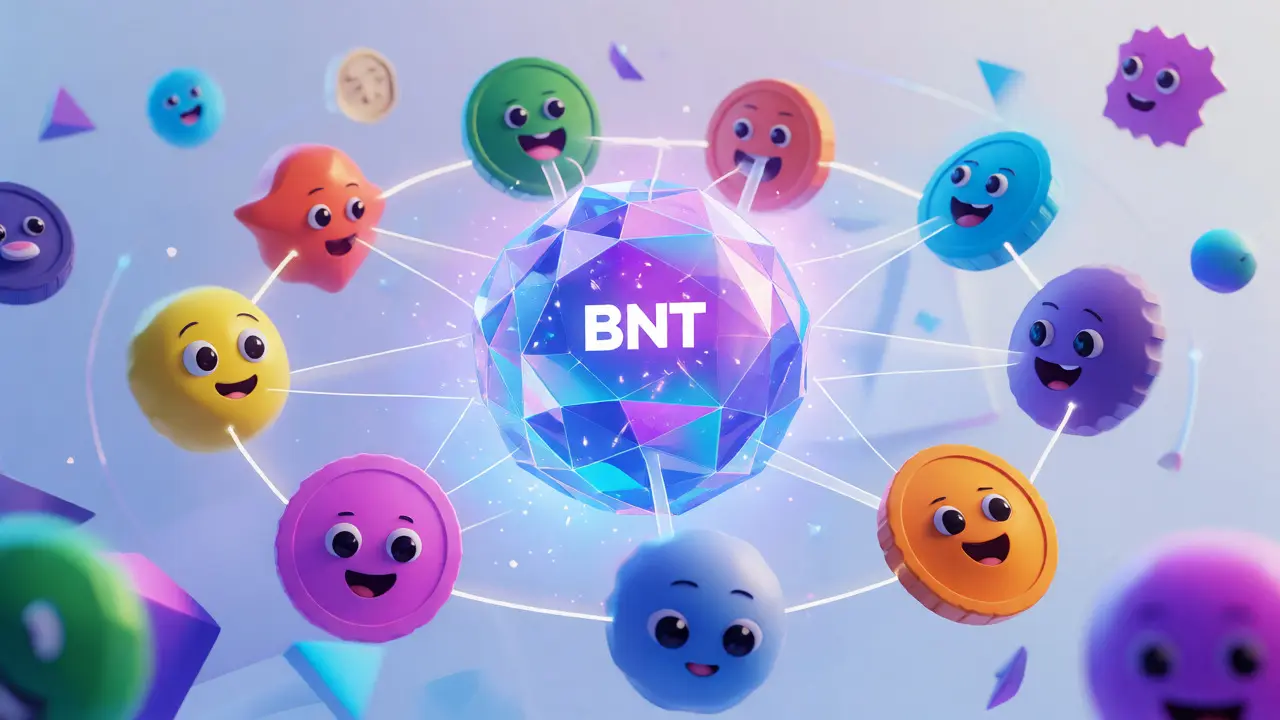
Here is where Bancor differs from competitors like Uniswap. Most AMMs require you to pair two volatile assets directly. Bancor uses BNT as a hub asset. Think of BNT as the universal translator. When you want to trade Token A for Token B, the protocol often routes through BNT. This structure allows for single-sided liquidity provision. You can lock up just Token A, and the protocol handles the rest by pairing it with BNT internally.
Why does this matter? It reduces the barrier to entry. You don’t need to hold a balanced portfolio of two risky assets to become a liquidity provider. You can just hold the asset you believe in. The BNT token isn't just a governance coin; it is the functional backbone that enables cross-token conversions and maintains the network's liquidity depth.
Impermanent Loss Protection: A Game Changer
If you’ve ever provided liquidity to a decentralized exchange, you know the fear of impermanent loss. It’s when the price of your deposited assets changes so much that you’d have been better off just holding them in your wallet. Bancor built a feature specifically to address this pain point. Their system offers compensation for eligible single-sided liquidity providers over time.
This doesn’t mean losses disappear instantly. It’s a gradual protection mechanism. The longer you keep your funds locked in the pool, the more protection you accrue. For long-term holders who want to earn yield but hate the volatility risk of standard AMMs, this is a massive draw. It turns liquidity providing into a more predictable income stream, rather than a high-stakes gamble on relative asset performance.
Carbon DeFi: Beyond Simple Swaps
Bancor didn’t stop at being a simple swap engine. They evolved into something more sophisticated with their flagship product, Carbon DeFi. This upgrade introduces orderbook-like features to the automated market maker world. Traditional AMMs have fixed pricing curves. Carbon allows users to create custom strategies. You can set up limit orders, grid trades, or dynamic ranges that adjust automatically as market conditions change.
Imagine you want to sell your ETH only if it hits $4,000, but you also want to buy back in if it drops to $3,500. On a standard AMM, you’d have to monitor the price manually. With Carbon, you define the parameters once, and the smart contract executes the strategy. It brings centralized exchange-style control to decentralized finance, all while keeping custody of your keys.
Multi-Chain Compatibility and Governance
Bancor was originally built on both Ethereum and EOS. While Ethereum remains the primary hub, the architecture was designed to be chain-agnostic. This flexibility is crucial in today’s fragmented blockchain landscape. Users can interact with the protocol across different networks, leveraging BNT as the bridge between ecosystems.
Governance is handled through the BancorDAO. Holding and staking BNT gives you voting rights on protocol upgrades, fee structures, and new feature implementations. It’s not just about speculation; it’s about steering the ship. As an ERC-20 token, BNT fits seamlessly into almost any wallet, from hardware devices like Ledger to software options like MetaMask or Rabby.

Is BNT a Good Investment?
Let’s look at the numbers. BNT has a fixed maximum supply of 69 million tokens. Scarcity is baked into the model. However, like all cryptocurrencies, its price is volatile. It derives value from utility-every trade that uses BNT as a connector creates demand. If the protocol grows, the utility of the token grows.
But don’t ignore the risks. Competition is fierce. Newer protocols offer higher yields or lower fees. BNT’s performance depends heavily on whether traders choose Bancor’s interface and Carbon’s advanced tools over simpler alternatives. It’s a play on the idea that users will eventually prioritize advanced strategy automation and risk management over basic swapping.
Frequently Asked Questions
What is the main difference between Bancor and Uniswap?
The biggest difference is liquidity provision. Uniswap typically requires users to deposit pairs of tokens in equal proportions. Bancor allows single-sided liquidity provision, meaning you can deposit just one type of token. Additionally, Bancor uses BNT as a central hub asset for conversions, whereas Uniswap uses direct token-to-token pools.
Does Bancor really protect against impermanent loss?
Yes, but with conditions. Bancor offers impermanent loss protection for eligible single-sided liquidity providers. The protection accumulates over time; the longer you stay in the pool, the higher the percentage of potential losses covered. It is not immediate full coverage upon deposit.
What is Carbon DeFi?
Carbon DeFi is Bancor’s advanced trading module. It allows users to build complex automated strategies, such as limit orders and grid trading, directly on-chain. It combines the simplicity of an AMM with the precision of an order book, giving traders more control over their entries and exits.
Can I stake BNT for rewards?
Yes. Staking BNT allows you to participate in the BancorDAO governance votes. Historically, stakers have also received a portion of the protocol’s trading fees, though reward mechanisms can evolve through governance proposals. Always check the current dashboard for live APR rates.
Which blockchains does Bancor support?
Bancor was initially launched on Ethereum and EOS. Today, it primarily operates on Ethereum Layer 1 and various Layer 2 solutions, expanding its reach to ensure low transaction costs and fast settlement times for users across different environments.
Next Steps for Traders
If you’re curious about Bancor, start small. Connect your wallet to the official interface. Try a small swap to see how the routing works. Then, explore the Carbon section to see how you might automate a simple buy-low-sell-high strategy. Remember, decentralized finance rewards those who understand the mechanics, not just the price charts. Do your own research, manage your position sizes, and never invest more than you can afford to lose in this highly experimental sector.