



Imagine earning Bitcoin not by burning electricity on massive server farms, but by mastering a 2D motorbike game. That was the pitch for Motocoin (MOTO). It wasn’t just another token; it introduced a proof-of-play consensus algorithm where your skill in navigating a virtual track determined your mining rewards. But here’s the harsh reality: if you’re looking to buy MOTO today, you’re likely buying into a ghost town. As of late 2026, Motocoin is classified as an abandoned project, with its last significant trading activity dating back to October 2019.
The Core Concept: Mining Through Gameplay
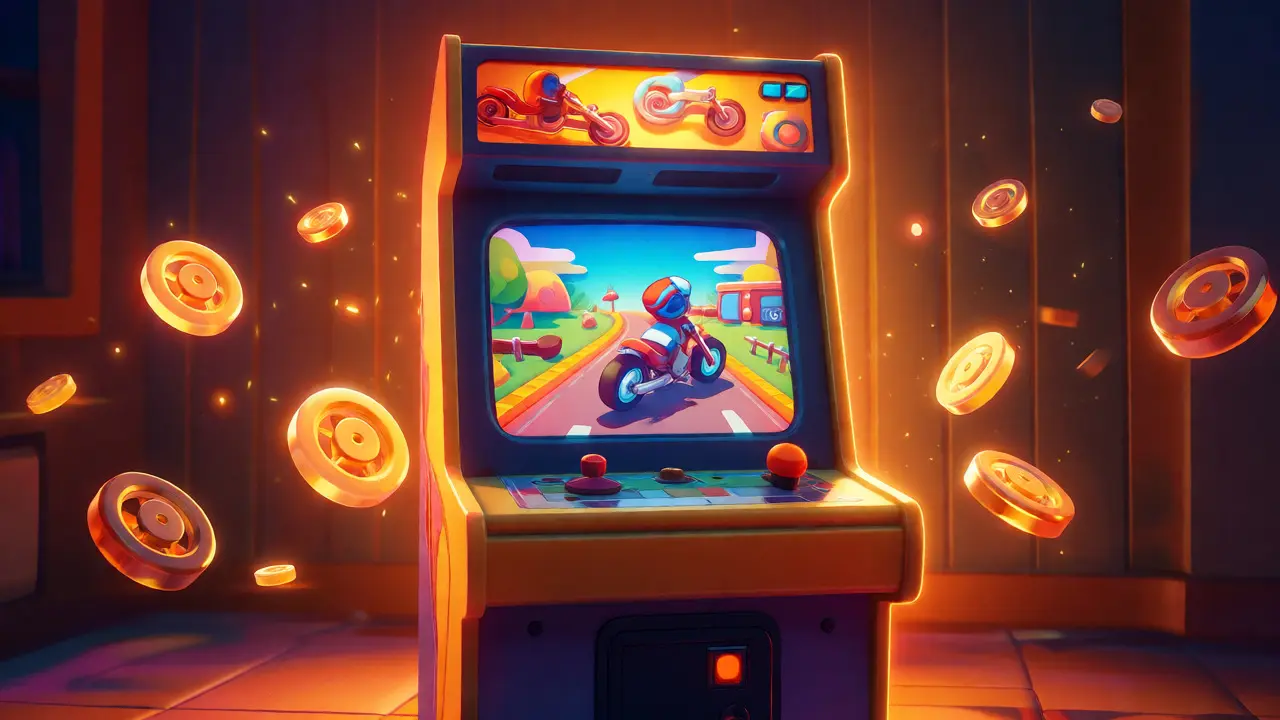
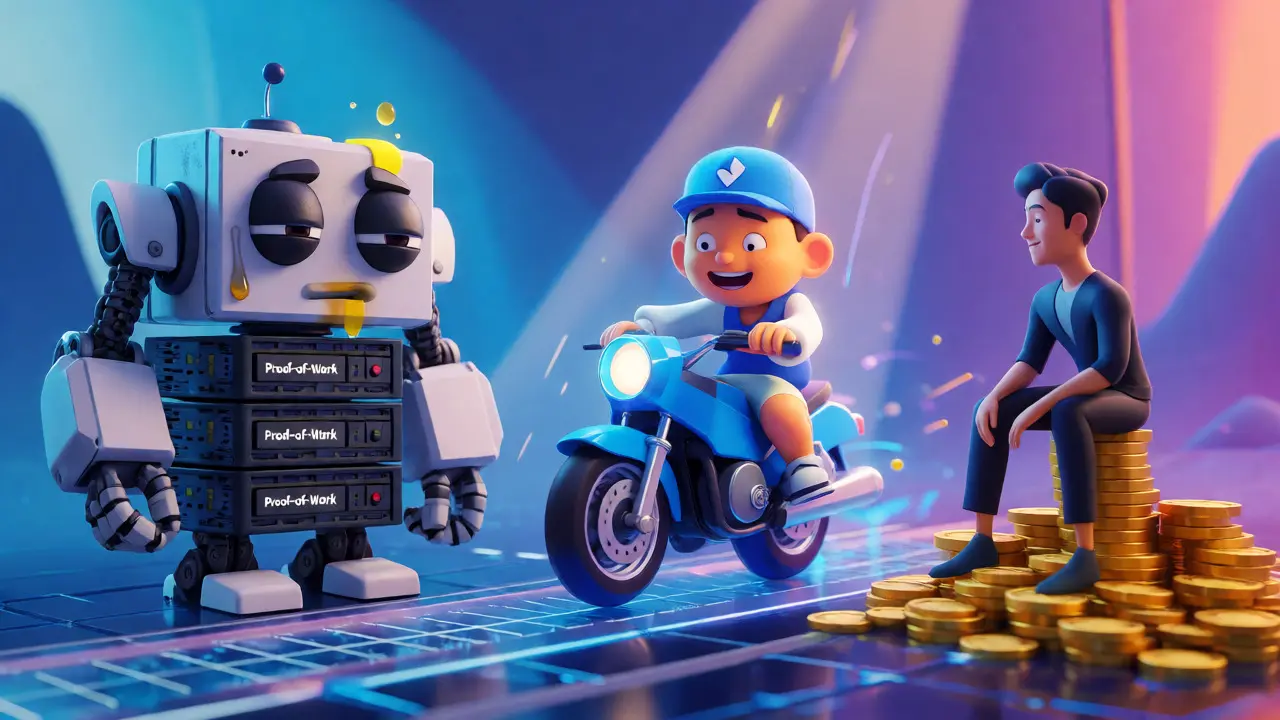
Most cryptocurrencies rely on computational power. Bitcoin uses Proof-of-Work, requiring miners to solve complex mathematical puzzles. Ethereum moved to Proof-of-Stake, locking up capital. Motocoin tried something radically different. It replaced raw computing power with human cognitive workload. To mine MOTO, you had to play a specific 2D motorbike simulation game. Your performance-how fast and efficiently you completed levels-was recorded on the blockchain. This approach aimed to reduce the environmental impact of mining while adding a layer of gamification that most digital currencies lack.
How Proof-of-Play Actually Worked
You might wonder how a video game can secure a blockchain. The technical implementation was surprisingly efficient. Instead of storing heavy data, the network stored "replays" of your gameplay. Each replay was a list of player actions, capped at 60 actions per play to keep the blockchain lightweight. Every action was encoded as a 16-bit integer, including delta time and the specific input. With 250 ticks per second, each replay consumed no more than 960 bits of storage. This design meant that difficulty adjustments weren't based on network hashrate (which doesn't exist in this model) but on the completion times of game levels. If players got too good, the game became harder. If they struggled, it eased up. It was a self-balancing ecosystem driven by human reflexes rather than silicon chips.
Current Market Status: A Ghost in the Machine
If you check major aggregators like CoinMarketCap or CryptoSlate today, the data tells a sad story. Prices fluctuate wildly between sources simply because there is almost no liquidity. One platform might show $0.01003, while another lists it at $0.004707. Why the discrepancy? Because the 24-hour trading volume is often near zero-sometimes reported as low as $14. This isn't a market in discovery mode; it's a graveyard. The circulating supply sits around 19.64 million MOTO tokens, giving it a market cap under $200K. For context, that places it in the bottom tier of thousands of defunct projects, ranking roughly #33,000+ globally. There are no active developer updates, no community forums buzzing with debate, and no roadmap for revival.
| Feature | Motocoin (Proof-of-Play) | Bitcoin (Proof-of-Work) | Ethereum (Proof-of-Stake) |
|---|---|---|---|
| Resource Required | Human Skill & Time | Electricity & Hardware | Capital Lockup |
| Environmental Impact | Very Low | High | Low |
| Accessibility | Requires Game Mastery | Specialized Hardware | Financial Barrier |
| Current Status | Abandoned | Active Leader | Active Leader |
Why Did It Fail?
Innovation alone doesn't sustain a cryptocurrency. Motocoin faced three fatal hurdles. First, scalability. While 960 bits per replay is small, scaling a network where every transaction requires a human to play a game is incredibly difficult compared to automated validators. Second, competition. By the time Motocoin launched, other gaming-focused blockchains were emerging with better graphics, deeper economies, and stronger marketing. Projects like Axie Infinity later proved that people would pay for fun, but they didn't necessarily want to grind a simple 2D bike sim to earn pennies. Third, and most critically, developer abandonment. When the core team stopped updating the code and fixing bugs, trust evaporated. Without a roadmap or active community management, the token became illiquid, and liquidity begets more liquidity-or in this case, the lack thereof.

Is MOTO Worth Buying Now?
Let’s be direct: unless you are a collector of obscure crypto history or a speculator betting on a miraculous resurrection, MOTO is not a viable investment vehicle. The technical indicators reflect this stagnation. The Relative Strength Index (RSI) hovers around neutral (50.99), showing no momentum. Trading ranges are tight ($0.00386 to $0.00481), indicating a complete lack of interest from buyers or sellers. You aren't buying exposure to a growing tech sector; you're holding a static asset with no yield, no staking rewards, and no utility beyond potential nostalgia. The risk of total loss is high, not because the price will crash (it's already near floor), but because it may never trade again.
Lessons from the Motocoin Experiment
Motocoin serves as a cautionary tale for the broader blockchain industry. It demonstrated that alternative consensus mechanisms are possible, but they must solve real problems better than existing solutions. Proof-of-play reduced energy consumption, yes, but it introduced friction that most users found unappealing. Modern gaming cryptos now focus on ownership of assets (NFTs) and interoperability rather than using gameplay itself as the primary mining mechanism. If you’re exploring crypto investments, look for projects with active GitHub repositories, regular developer communications, and transparent governance. Motocoin has none of these. It remains a fascinating footnote in blockchain evolution-a reminder that even the cleverest ideas die without community support and continuous development.
Can I still mine Motocoin?
Technically, you can download the old client and play the game, but it is practically useless. Since the network is abandoned, there are no new blocks being generated consistently, and any coins you mine have virtually no exchange rate value due to zero liquidity. Most exchanges have delisted it entirely.
Where can I buy MOTO tokens?
Major exchanges like Binance or Coinbase do not list MOTO. You might find sporadic listings on smaller, less reputable decentralized exchanges or legacy platforms, but spreads are wide, and volume is negligible. Be cautious of fake listings.
Is Motocoin safe to hold?
The blockchain itself hasn't been hacked recently, so the ledger is stable. However, "safe" in investing terms means protected against total value loss. Given the abandoned status, the risk is extreme. There is no security team monitoring for threats or updating protocols.
What happened to the Motocoin developers?
Public records indicate the development team ceased activity around 2019. There was no official announcement of dissolution, which is common for early-stage altcoins that fail to gain traction. They likely moved on to other projects or left the industry.
Are there similar active projects?
Yes, but they use different models. Games like Axie Infinity, The Sandbox, and Decentraland integrate crypto through NFT ownership and in-game economies rather than making gameplay the sole method of securing the network. These projects have active communities and higher liquidity.