





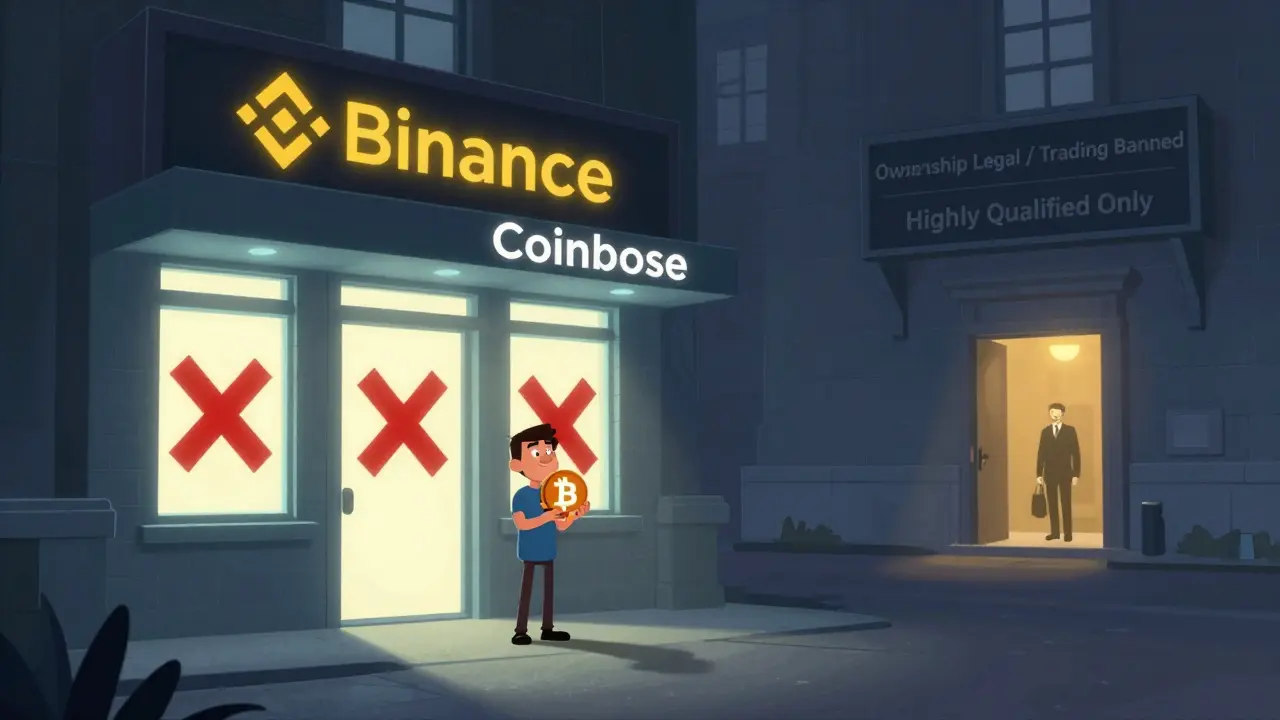
By 2025, Russian citizens face one of the harshest crypto environments in the world. If you're living in Russia and want to buy, sell, or hold Bitcoin or Ethereum, you're not just fighting market volatility-you're fighting a government that actively blocks you from the global crypto system. The rules aren't just confusing; they're designed to keep ordinary people out while letting a tiny elite play by different rules.
Ownership Is Legal. Trading Is Not.
It sounds like a trick question, but here’s the truth: owning cryptocurrency is legal in Russia. You won’t go to jail for holding Bitcoin in a wallet. But using it to pay for groceries, sending it to a friend, or buying it through a Russian bank? That’s where things collapse.
The foundation was laid in 2021 when Russia passed Law No. 259-FZ. It said crypto could be owned, but not used as money. That meant no crypto payments in stores, no crypto salaries, no crypto loans from Russian banks. The government didn’t ban crypto-it just made it useless for daily life. Then came the sanctions after 2022, and everything got worse.
The Two-Tier System: Elites Only
While regular Russians are locked out, a small group has a backdoor. In mid-2023, Russia created the Experimental Legal Regime (ELR). This lets approved companies-mostly state-linked or oligarch-backed-use crypto for international trade. Think oil, gas, or weapons suppliers trading with countries that still accept rubles. These firms can move crypto across borders without triggering Western sanctions, because the Russian government explicitly authorized it.
For everyone else? The Central Bank of Russia says you need to be a "highly qualified investor." That means either having over 100 million rubles ($1.1 million USD) in investments, or earning more than 50 million rubles ($550,000 USD) a year. That’s less than 0.1% of the population. If you’re not in that group, you’re not supposed to trade crypto at all. Not legally. Not through banks. Not through licensed platforms.
What Happens When You Try to Use Binance or Coinbase?
Most Russians who try to use global exchanges like Binance or Coinbase hit a wall. In 2022, you could sign up with just an email. Now, you need proof of address, a foreign ID, and sometimes even a video call with someone outside Russia. Coinbase has frozen over 25,000 Russian accounts since 2022. Binance, which used to be the go-to for Russian traders, now blocks withdrawals for anyone with crypto holdings over €10,000.
Trustpilot reviews from Russian users tell the story: Coinbase has a 2.1/5 rating. Binance is at 2.8/5. The complaints? Accounts frozen without warning. KYC rejections even when you send the right documents. Customer service that doesn’t reply. And if you’re using a VPN to access these platforms? That’s another red flag. The Bank of Russia has warned that using a VPN for crypto trading could get your bank account blocked.

The P2P Trap: The Only Option Left
With banks and exchanges shutting the door, Russians turned to peer-to-peer (P2P) trading. Platforms like LocalBitcoins and Paxful became lifelines. You find someone willing to sell Bitcoin for Russian rubles via bank transfer, cash deposit, or even gift cards. It’s messy, risky, and slow-but it’s the only way most people can get crypto.
Here’s the catch: the Central Bank has openly warned that frequent small P2P trades can trigger automatic bank account freezes. In June 2023, they said these transactions look like money laundering. So now you’re stuck: if you trade crypto, your bank might shut you down. If you don’t trade, you lose access to any real financial freedom.
A September 2025 survey by Coincub found that 79% of Russian crypto users struggle to cash out rubles. 68% failed identity checks. 41% had accounts frozen unexpectedly. This isn’t a glitch-it’s the system working as intended.
Why the Government Does This
Why would a country that has millions of crypto owners actively block them? Because the goal isn’t to stop crypto-it’s to control capital.
Western sanctions cut Russia off from SWIFT, dollar reserves, and global banking. The Kremlin needed a way to keep trade flowing without using traditional systems. That’s why the ELR exists: to let sanctioned companies move value through crypto while keeping it away from ordinary citizens. If Russians could freely buy Bitcoin, they’d likely move their savings out of the ruble. That would hurt the currency, destabilize the economy, and weaken the government’s grip.
It’s also about control. By making crypto access exclusive, the state creates a financial aristocracy-people who can play by the rules and still profit. Everyone else? They’re pushed into the shadows, where they’re easier to monitor, punish, or ignore.

What About Russian Exchanges?
There are no major Russian crypto exchanges left in the top 100 global platforms. All the big names-Binance, Kraken, Bybit-are blocked or restricted. The few platforms that still operate under Russian jurisdiction are either defunct or have moved offshore to avoid sanctions. Even if you find one, it’s likely unregulated, risky, and possibly a scam.
Chainalysis reports that 87% of all crypto transactions by Russian users now happen outside any regulated system. That means no KYC, no oversight, no protection. It’s a black market, but it’s the only one left.
Is There Any Hope for Change?
In October 2025, the Bank of Russia announced banks could finally enter the crypto sector-but with heavy limits. They can’t make crypto their main business. They must keep crypto exposure under 1% of their capital. And they still can’t offer services to ordinary citizens.
Some reports suggest the Finance Ministry might lower the "highly qualified investor" threshold. But no concrete changes have been made. Experts at Bernstein predict Russia’s crypto market will stay fractured until at least 2028. The only real path forward for most people is decentralized finance (DeFi)-using wallets like MetaMask, swapping tokens on Uniswap, or earning yield on platforms that don’t ask for your ID. But even that comes with risks: no customer support, no chargebacks, no legal recourse if you get hacked.
The Bigger Picture: Can Crypto Bypass Sanctions?
Some people believed Bitcoin could help Russia dodge Western sanctions. That didn’t happen. Major exchanges strictly follow sanctions rules. The U.S. Treasury says laundering large sums through crypto is expensive, slow, and easy to track. Blockchain analytics firms like Chainalysis and Elliptic work with law enforcement to flag suspicious flows in real time.
Bitcoin didn’t save Russia from sanctions. It just created a new kind of prison-one where the rich can escape, and everyone else is locked inside.
Can Russian citizens legally buy cryptocurrency in 2025?
Owning cryptocurrency is legal in Russia, but buying or selling it through banks or licensed exchanges is effectively banned for ordinary citizens. Only "highly qualified investors" with over 100 million rubles in assets are officially allowed to trade. Everyone else must rely on offshore platforms or peer-to-peer markets, which carry high legal and financial risks.
Why can't I use Binance or Coinbase if I'm from Russia?
Binance and Coinbase comply with international sanctions. Since 2022, they’ve frozen tens of thousands of Russian accounts and restricted services to avoid legal penalties. New rules require strict KYC, including foreign IDs and proof of address-documents most Russians can’t provide. Withdrawals are blocked for accounts holding over €10,000, and using a VPN to access these platforms can trigger bank account freezes.
What happens if my bank account gets blocked for crypto trading?
If your bank detects frequent P2P crypto transactions-even small ones-it can freeze your account under Central Bank guidelines. You may lose access to your rubles for weeks or months. There’s no formal appeal process, and banks aren’t required to explain why. Many users report being locked out without warning, even if they never used an exchange.
Is P2P crypto trading safe in Russia?
P2P trading is the only option for most Russians, but it’s dangerous. Sellers can disappear after you send money. Buyers can report you to the bank for "suspicious activity." There’s no insurance, no chargebacks, and no legal protection. The Central Bank has warned that frequent P2P trades can lead to account freezes, making it a high-risk workaround, not a solution.
Can I use DeFi to avoid Russian crypto restrictions?
Yes, DeFi platforms like MetaMask, Uniswap, or Aave don’t require identity verification, so they’re popular among Russian users. But they come with serious downsides: no customer support, no recovery if you lose your private key, and no protection from hacks or scams. You’re fully responsible for your funds. It’s not regulated, but it’s the closest thing to freedom left.
Will Russian crypto restrictions ever be lifted?
Unlikely for ordinary citizens. The government’s goal isn’t to enable crypto-it’s to control capital. The Experimental Legal Regime exists to serve sanctioned trade, not public access. Experts predict restrictions will remain tight until at least 2028. Any easing will likely benefit only the wealthy few who already meet the "highly qualified investor" standard.


Write a comment